From LUNGS: Re East River Park

A joint hearing on East River Park is being held by the City Council on Wednesday, January 23, at 1pm at City Hall. 

A Press Conference is being held at Noon on the Steps of City Hall on the East River Park Plan. We need gardeners to  turn out in garden colors, with signs and numbers to show our strength and unity of our community.

We are in the middle of a struggle to preserve East River Park. We are fighting the proposed plan and its implementation. The City intends to close the entire park for at least 3 1/2 years beginning next Spring.

That means no baseball, no running, no dog walking, no people walking, no barbeques , soccer, frisbee, tennis, bicycling, no nothing. This will disrupt our entire neighborhood. Kids, the elderly, families, schools, everyone’s life will be impacted by the shutdown.

LUNGs has been actively involved with a new community group, The East River Alliance, to resist this new plan. Our major concern is lack of community input, the environmental impact, concerns not addressed in the  proposed plan and closing the entire Park for such an extended period of time. 

The East River Alliance and LUNGS are preparing testimony for the hearing. Other groups are welcome to testify and  anyone who wishes to is encouraged to a prepare personal testimony.  You don’t need to testify but you need to be there, please save the time and the date, be at City Hall at 11:30 am on Wednesday, Jan 32 for the Press Conference.

The community is getting its first chance to speak out publicly:  to officially raise hell about their concerns with the new plan. The City Council hearing on the East Side Coastal Resiliency(ESCR) project will be Wednesday, January 23rd at 1:00 PM at City Hall. Press Conference at NOON.  Councilwoman Carlina Rivera will be there advocating on our behalf, and she has asked us to rally as many folks as possible to attend. We are asking M’Finda Kalunga to send at least two gardeners to this hearing, we need your support this is going to effect all of us.  

For more info at the LUNGSNYC.Org website

Read MoreFrom LUNGS: Re East River Park
  • Post category:News

NYTimes: “To Save East River Park, the City Intends to Bury It”

NYTimes:

[Valenteena] Jones, Lower East Side resident and CB3 Board member: “The way this planning is being done is disempowering. City officials collaborated with us over four years and came up with a detailed design — only to now return with this entirely new design. Do our voices even matter?”

The city’s latest plan to protect from future flooding called for burying the park under eight to 10 feet of landfill, and starting over. This was not the original plan.

Council Woman Carlina Rivera: “The community’s painstaking work over four years is being completely pushed aside. The new plan represents a fundamental departure from anything the City had discussed. The mayor’s office has failed to provide detailed analyses on why the cost increase is necessary. Until those questions are answered, I cannot back the direction the mayor’s office has taken.”

City Council oversight meeting next Tuesday that will address the new park plans.


Rebuild by Design’s Amy Chester: “This renewal project did not come through normal city channels. Its first target was the LES whose low-lying public housing is especially vulnerable. The berm surrounding the park would be the first link in a string of buffers around all Lower Manhattan — known as the Big U — to protect against rising seas – until the city announced in September, with no community consultation, that the plan was being scrapped.”

Now those who live near the park are frustrated that the plan to preserve the ecosystem is being swept aside.

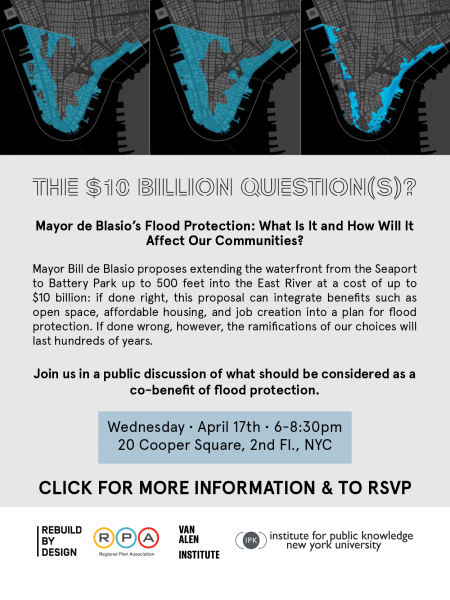
The original plan was budgeted at $760 Million; the city’s revised scheme would cost $1.45 Billion.

HUD will kick in $330 million but the agency required this money be spent by 2022 or be forfeited.

Christine Datz-Romero director of the Lower East Side Ecology Center (the environmental organization headquartered in the park’s fireboat house). “Nearly all these would be buried under the new plan, replaced by saplings that would take decades to mature. The new plan will also create a temporary ecological desert for hundreds of species migrating the Atlantic Flyway.

“We agree we need to protect our community, but ..why .. destroy a park to do so.”

She envisions the park as a floodplain, slowing and absorbing rising waters with salt-tolerant Juniper and sumac trees her volunteers have already planted.

“We have seen no environmental impact statement addressing any of this. Instead, we are told little, our concerns steamrollered,”

“For several years, the Ecology Center (has assisted the Parks Department’s gardener in planting the park: hundreds of echinaceas, a coneflower with medicinal properties; 15,000 bluebells; and milkweed to attract monarch butterflies. Volunteers also cared for the park’s hundreds of lindens, oaks, and London plane trees.”

Commissioner Grillo: A draft impact statement will be issued this March, just before the city certifies the proposed plan.

The city plans to increase tree species from the original 3 to 52 hardier ones; by planting 1,300 trees on fresh, raised soil, the new park will resurrect that canopy. [good idea but the city can do that without razing the park]

Buried, too, will be the running track field house with its sea monster tiles and the track itself (just refurbished for nearly $3 million). The fate of the amphitheater, the original home to Shakespeare in the Park, now home to Summer Stage salsa concerts, remains uncertain.”

… Joan Reinmuth, a retired nurse and 30-year East Village resident: “This park is more than a recreation facility. These kids in NYCHA houses don’t take vacation cruises. They don’t shop at Zabar’s for fish; they fish to eat. Early mornings, men are shaving in the fountains.”

Read MoreNYTimes: “To Save East River Park, the City Intends to Bury It”
  • Post category:News

From: The East River Alliance

With thanks to Jamie Rogers for his effective efforts to organize the community to move forward in this critical time.

From the East River Alliance:

We are the East River Alliance

Hello Everyone,

The results of the Google poll and feedback from last week’s meeting
were definitive – the majority chose the East River Alliance as the name of our community group dedicated to articulating our questions,
concerns and demands around the ESCR project.

As the name implies, we have a big job to do. Now let’s get down to business. Here is a schedule of our upcoming committee meetings:

Wednesday, January 16, 6:30 pm (TODAY)
Outreach and Communications Committee
Educational Alliance – 29 Avenue D (3&4), Room 101
 
Thursday, January 17, 6:30 pm
Park Assets and Stewardship Committee
Educational Alliance –  29 Avenue D (3&4), Room 101
 
Tuesday, January 22, 6:30 pm
Construction Mitigation and Meeting Community Needs Committee
Educational Alliance – 29 Avenue D (3&4), Room 101  

City Council hearing on the ESCR project will be:
Wednesday, January 23rd at 1:00PM at City Hall.
We will work on preparing testimony for the group and can help anyone who wishes to prepare personal testimony. 

Also, here are some important resources to get up to speed:
NYC Department of Design & Construction’s January 10, 2018,
presentation to the Parks Committee of Community Board 3

Rebuild by Design East River Park Stewardship Study

Primer on the Uniform Land Use Review Procedure

We will be sending out more information soon from each committee and to schedule our next group meeting. 

Thank you all for your hard work and dedication to keeping the ESCR a
community-driven project and working to create a resilient park we can be proud of.
Yours,
Jamie  
Read MoreFrom: The East River Alliance
  • Post category:News

THE GREEN NEW DEAL

Summary of the Green New Deal

The Green New Deal is a four part program for moving America quickly out of crisis into a secure, sustainable future. Inspired by the New Deal programs that helped us out of the Great Depression of the 1930s, the Green New Deal will provide similar relief and create an economy that makes our communities sustainable, healthy and just.

THE FOUR PILLARS OF THE GREEN NEW DEAL

I – THE ECONOMIC BILL OF RIGHTS

Our country cannot truly move forward until the roots of inequality are pulled up, and the seeds of a new, healthier economy are planted. Thus, the Green New Deal begins with an Economic Bill of Rights that ensures all citizens:

1. The right to employment through a Full Employment Program that will create 25 million jobs by implementing a nationally funded, but locally controlled direct employment initiative replacing unemployment offices with local employment offices offering public sector jobs which are “stored” in job banks in order to take up any slack in private sector employment.

  • Local communities will use a process of broad stakeholder input and democratic decisionmaking to fairly implement these programs.
  • Pay-to-play prohibitions will ensure that campaign contributions or lobbying favors do not impact decision-making.
  • We will end unemployment in America once and for all by guaranteeing a job at a living wage for every American willing and able to work.

2. Worker’s rights including the right to a living wage, to a safe workplace, to fair trade, and to organize a union at work without fear of firing or reprisal.

3. The right to quality health care which will be achieved through a single-payer Medicare-for-All program.

4. The right to a tuition-free, quality, federally funded, local controlled public education system from pre-school through college. We will also forgive student loan debt from the current era of unaffordable college education.

5. The right to decent affordable housing, including an immediate halt to all foreclosures and evictions. We will:

  • create a federal bank with local branches to take over homes with distressed mortgages and either restructure the mortgages to affordable levels, or if the occupants cannot afford a mortgage, rent homes to the occupants;
  • expand rental and home ownership assistance;
  • create ample public housing; and,
  • offer capital grants to non-profit developers of affordable housing until all people can obtain decent housing at no more than 25% of their income.

6. The right to accessible and affordable utilities – heat, electricity, phone, internet, and public transportation – through democratically run, publicly owned utilities that operate at cost, not for profit.

7. The right to fair taxation that’s distributed in proportion to ability to pay. In addition, corporate tax subsidies will be made transparent by detailing them in public budgets where they can be scrutinized, not hidden as tax breaks.

II – A GREEN TRANSITION

The second priority of the Green New Deal is a Green Transition Program that will convert the old, gray economy into a new, sustainable economy that is environmentally sound, economically viable and socially responsible. We will:

1. Invest in green business by providing grants and low-interest loans to grow green businesses and cooperatives, with an emphasis on small, locally-based companies that keep the wealth created by local labor circulating in the community rather than being drained off to enrich absentee investors.

2. Prioritize green research by redirecting research funds from fossil fuels and other dead-end industries toward research in wind, solar and geothermal. We will invest in research in sustainable, nontoxic materials, closed-loop cycles that eliminate waste and pollution, as well as organic agriculture, permaculture, and sustainable forestry.

3. Provide green jobs by enacting the Full Employment Program which will directly provide 16 million jobs in sustainable energy and energy efficiency retrofitting, mass transit and “complete streets” that promote safe bike and pedestrian traffic, regional food systems based on sustainable organic agriculture, and clean manufacturing.

III – REAL FINANCIAL REFORM

The takeover of our economy by big banks and well-connected financiers has destabilized both our democracy and our economy. It’s time to take Wall Street out of the driver’s seat and to free the truly productive segments of working America to make this economy work for all of us. Real Financial Reform will:

1. Relieve the debt overhang holding back the economy by reducing homeowner and student debt burdens.

2. Democratize monetary policy to bring about public control of the money supply and credit creation. This means we’ll nationalize the private bank-dominated Federal Reserve Banks and place them under a Monetary Authority within the Treasury Department.

3. Break up the oversized banks that are “too big to fail.”

4. End taxpayer-funded bailouts for banks, insurers, and other financial companies. We’ll use the FDIC resolution process for failed banks to reopen them as public banks where possible after failed loans and underlying assets are auctioned off.

5. Regulate all financial derivatives and require them to be traded on open exchanges.

6. Restore the Glass-Steagall separation of depository commercial banks from speculative investment banks.

7. Establish a 90% tax on bonuses for bailed out bankers.

8. Support the formation of federal, state, and municipal public-owned banks that function as non-profit utilities.

Under the Green New Deal we will start building a financial system that is open, honest, stable, and serves the real economy rather than the phony economy of high finance.

IV – A FUNCTIONING DEMOCRACY

We won’t get these vital reforms without a fourth and final set of reforms to give us a real, functioning democracy. Just as we are replacing the old economy with a new one, we need a new politics to restore the promise of American democracy. The New Green Deal will:

1. Revoke corporate personhood by amending our Constitution to make clear that corporations are not persons and money is not speech. Those rights belong to living, breathing human beings – not to business entities controlled by the wealthy.

2. Protect our right to vote by supporting Rep. Jesse Jackson, Jr.’s proposed “Right to Vote Amendment,” to clarify to the Supreme Court that yes, we do have a constitutional right to vote.

3. Enact the Voter Bill of Rights that will:

  • guarantee us a voter-marked paper ballot for all voting;
  • require that all votes are counted before election results are released;
  • replace partisan oversight of elections with non-partisan election commissions;
  • celebrate our democratic aspirations by making Election Day a national holiday;
  • bring simplified, safe same-day voter registration to the nation so that no qualified voter is barred from the polls;
  • do away with so-called “winner take all” elections in which the “winner” does not have the support of most of the voters, and replace that system with instant runoff voting and proportional representation, systems most advanced countries now use to good effect;
  • replace big money control of election campaigns with full public financing and free and equal access to the airwaves;
  • guarantee equal access to the ballot and to the debates to all qualified candidates;
  • abolish the Electoral College and implement direct election of the President;
  • restore the vote to ex-offenders who’ve paid their debt to society; and,
  • enact Statehood for the District of Columbia so that those Americans have representation in Congress and full rights to self rule like the rest of us.

4. Protect local democracy and democratic rights by commissioning a thorough review of federal preemption law and its impact on the practice of local democracy in the United States. This review will put at its center the “democracy question” – that is, what level of government is most open to democratic participation and most suited to protecting democratic rights.

5. Create a Corporation for Economic Democracy, a new federal corporation (like the Corporation for Public Broadcasting) to provide publicity, training, education, and direct financing for cooperative development and for democratic reforms to make government agencies, private associations, and business enterprises more participatory.

6. Strengthen media democracy by expanding federal support for locally-owned broadcast media and local print media.

7. Protect our personal liberty and freedoms by:

  • repealing the Patriot Act and those parts of the National Defense Authorization Act that violate our civil liberties;
  • prohibiting the Department of Homeland Security and the FBI from conspiring with local police forces to suppress our freedoms of assembly and of speech; and,
  • ending the war on immigrants – including the cruel, so-called “secure communities” program.

8. Rein in the military-industrial complex by

  • reducing military spending by 50% and closing U.S. military bases around the world;
  • restoring the National Guard as the centerpiece of our system of national defense; and,
  • creating a new round of nuclear disarmament initiatives.

Let us not rest until we have pulled our nation back from the brink, and until we have secured the peaceful, just, green future we all deserve.

Read MoreTHE GREEN NEW DEAL
  • Post category:News

From LUNGS:

Stay Green Lungsters,

The planned destruction of East River Park is going to greatly affect our gardens. LUNGS is holding a public meeting this Thursday, January 17, at 7pm at 428 E10th St.(C&D) to discuss the situation.

We are in the middle of a struggle to preserve East River Park. We are fighting the proposed plan and its implementation. The City intends to close the entire park for at least 3 1/2 years beginning next Spring.

That means no baseball, no running, no dog walking, no people walking, no barbeques , soccer, frisbee, tennis, bicycling, no nothing. This will disrupt our entire neighborhood. Kids, the elderly, families, schools, everyone’s life will be impacted by the shutdown.

And the gardens need to be prepared. We will have to open our garden gates and welcome the community to an even greater extent than we do now.  People will need our green spaces for gatherings, to play tag, to bbq and to just to hang out.

The gardens are going to be hubs of increasing activity. We will have to be open longer hours to meet community needs. This will require greater diligence and more maintenance. Neighborhood needs are going to require more time and an even greater spirit of community from gardeners. There will be more pressure to volunteers.  We need to recognize this, talk it over and strategize.

A Joint hearing on East River Park by the City Council’s committees on Parks and Environmental Protection is scheduled for Wednesday, January 23, at 1pm at City Hall. We must turn out in numbers to voice our opposition to the plan.

Our city council member, Carlina Rivera, requested the hearing and has stated:

“This hearing will finally give the Council and our community the chance to hear directly from the Mayor’s team and relevant agency commissioners regarding the recent changes to this monumental coastal protection project. Even with multiple community briefings and meetings with elected officials, we still do not have important details about this project, and I expect the Mayor’s team to come well prepared and help us understand the need for these drastic changes

Read MoreFrom LUNGS:
  • Post category:News

East River Park – A Biodiversity of Life: People and Plants!

Long-time stewards of East River Park have been attempting to go through and verify species’ identities. Their working tally (327) is most “certainly an underestimate” With the trees on their list being the largest and most conspicuous organisms.


The ever-growing species count for the East River Park. The information was extracted from eBird and iNaturalist:

Stewards vividly remember Sandy…

And question: “Why can’t we have a park, including athletic fields AND hospitable to biodiversity, that is designed to withstand and absorb occasional floods?”

Lower East Side Ecology Center – Pioneering Urban Sustainability Since 1987 Check out their website.

Read MoreEast River Park – A Biodiversity of Life: People and Plants!
  • Post category:News

M’Finda Kalunga Garden to Get Long-Awaited Permeable Pavers

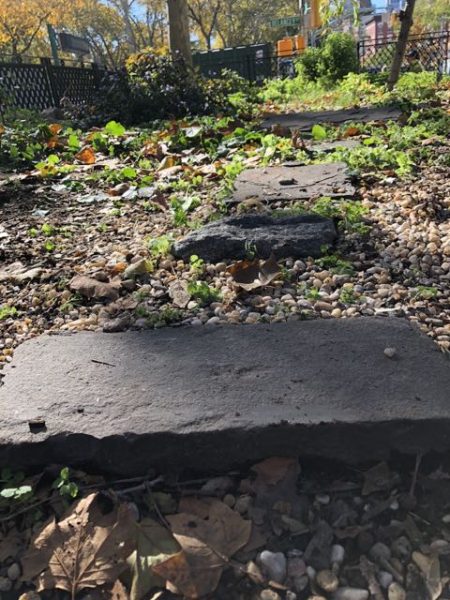
Although the design will need to be modified regarding the turtle pond (and no berm needed) and placement of pollinator garden, the addition of solar powered microgrids and permeable pavers for the pathways will make them more the garden more resilient and improve accessibility for the seniors using the BRC Center during the weekdays and for the public on Thursday evenings and weekends.

The garden membership will review before plans are finalized.

Garden Co-Chair Jen Izkowitz and SDR Coalition President K Webster met with Elizabeth Martinez and Angelo (both our Park Department Officials) along with Lisa Sabella Project Development Coordinator with GreenThumb.

Thanks to Parks Department and GreenThumb, the long-time advocacy of LUNGS and Gardens Rising and our Garden members Jane Barrer and others.

Read MoreM’Finda Kalunga Garden to Get Long-Awaited Permeable Pavers
  • Post category:News

From NYers4Parks re: East Side Coastal Resiliency Project:

City Council Parks Committee hearing on the East Side Resiliency Project has been scheduled for the afternoon of Wednesday, January 23rd at 1pm at City Hall. NY4P will be there to testify, and we encourage you all to join and send members of your coalitions as well to both listen and participate in the hearing to share your experiences and thoughts about this project. We are going to start doing more intensive research on our end as we prepare our testimony, but would welcome your thoughts and feedback as direct stakeholders in this project. We’d also welcome your help in sharing the news about this hearing to folks in your network who may also be interested in attending.

Read MoreFrom NYers4Parks re: East Side Coastal Resiliency Project:
  • Post category:News

Rivington House Update

Photo from video Pridgen (2010) Directed by Fury Young Film shot by Christopher Cafaro

Despite the notorious scandal and subsequent 3 1/2 year fight by the community to return Rivington House to its role as nursing home facility AND the well-publicized fact that Neighbors to Save Rivington House along with elected representatives were in the midst of negotiations with Slate Property Group (or… a simple google search?) Neighbors to Save Rivington House learned (along with elected representatives) that Mount Sinai had signed a Letter of Intent with Slate on behalf of their own desired project to take over the entire building to create a Behavioral Health facility. Apparently they would like to remove these current services from their newly acquired downsized Beth Israel site (Bernstein Building) to our neighborhood.

At a recent CB3 Health and Human Services Committee Meeting, Mount Sinai/Beth Israel claimed they had no awareness of Neighbors to Save Rivington House struggle to reclaim the building for this community nor that we were in negotiations alongside elected offic.

From the Real Deal video on the Rivington House controversy 

If Mount Sinai succeeds this could have differing impacts here: some potentially good, some potentially troubling. We don’t know enough yet what this means for this park. It is not clear that Mount Sinai thought about their desired new location in terms of the current challenges within this park.

Below are three responses from Neighbors to Save Rivington House: a perspective on being pitted against others in need, an Open Letter and a Letter after meeting with MSBI.  Media reporting linked below.

Also included is a CB3 Resolution on the original Mount Sinai Beth Israel plan to downsize their current ‘campus’ and this link to the Villager article  on the details of the original Beth Israel site and Mount Sinai’s plans for downsizing it.

We will share whatever information we are able to get.


First, this, prior to a CB3 Health Committee Meeting:

“This is the neighborhood that welcomed Rivington House for people with AIDS/HIV.

We won’t be pitted against people who desperately need a home and/or services. Never have. Never will. 

We share.

That is in fact one issue with this sudden announcement: potentially, people in crisis would be pitted against each other – that is unacceptable. As was not vetting this plan through elected officials here before any “Letter of Intent” was signed.

We are asking to share space with Mount Sinai/Beth Israel. The community fought 3 1/2 years to “preserve” this tremendous resource. Rivington House represents 219 ‘homes’ (beds). This was always housing for the disabled, for those stricken with illness requiring 24/7 long-term care, or for those who were dying. 

We want to build a model of “nursing home” care that would be integrated into our neighborhood for people with Alzheimers, other dementias, other debilitating diseases, and to return the former evicted tenants who are living with AIDS/HIV. 

We want to share this building which could be an activated community hub for many real needs here.

We’ll be there. Continuing to fight for people whose minds are being slowly taken by yet another disease with no cure, that people die from.” – K

Craine’s

The Villager

Lo-Down

Patch


Read MoreRivington House Update
  • Post category:News