Bob Humber’s Page: A glimpse into a life well lived.


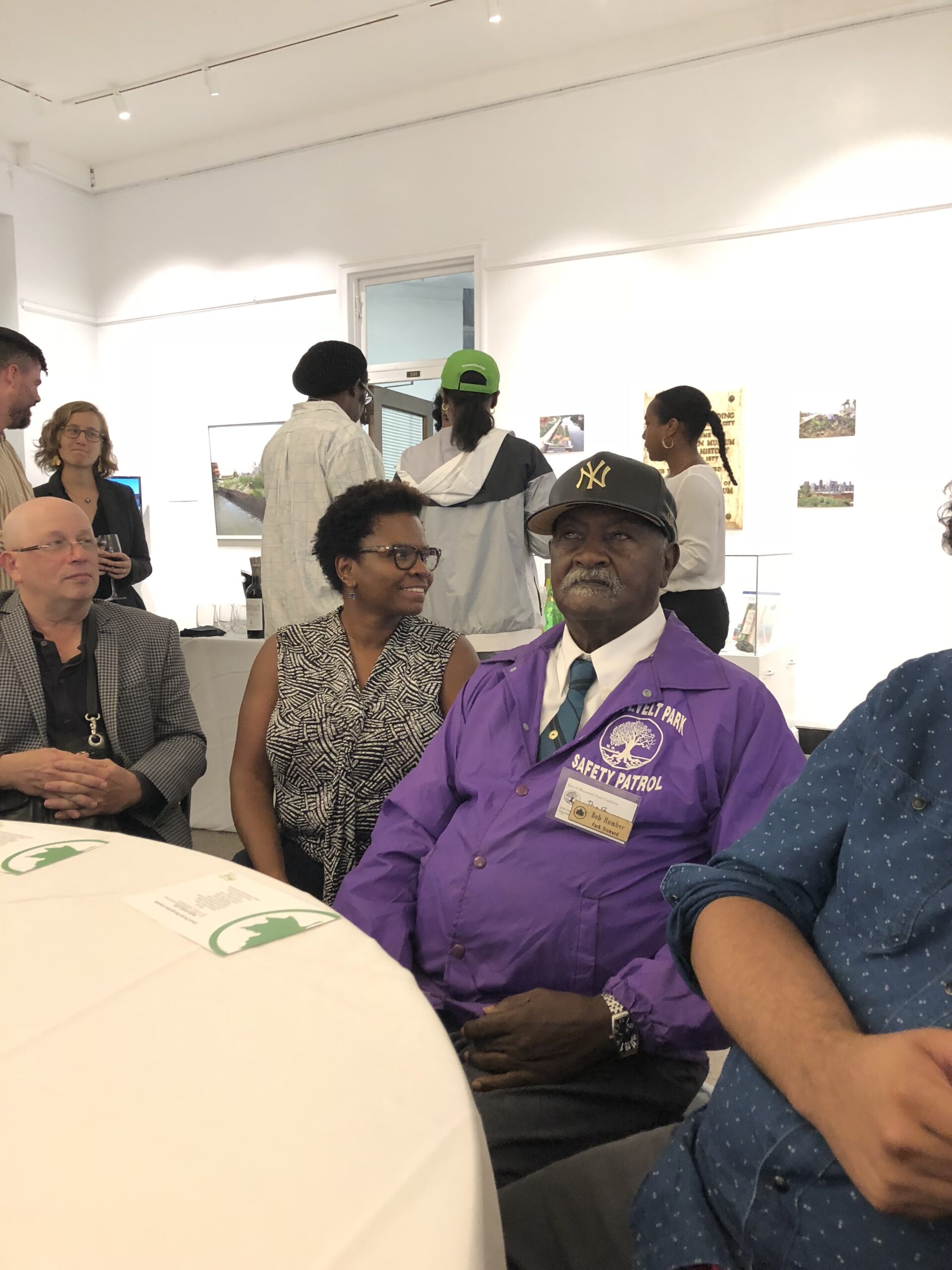
Bob Humber Hero Award Winner 2018:
This won’t be able to capture the love of community, the sweet smile and warm welcome, the extended hand and ready joke, the calm courage and the kindness and wisdom of Bob Humber. But here goes:
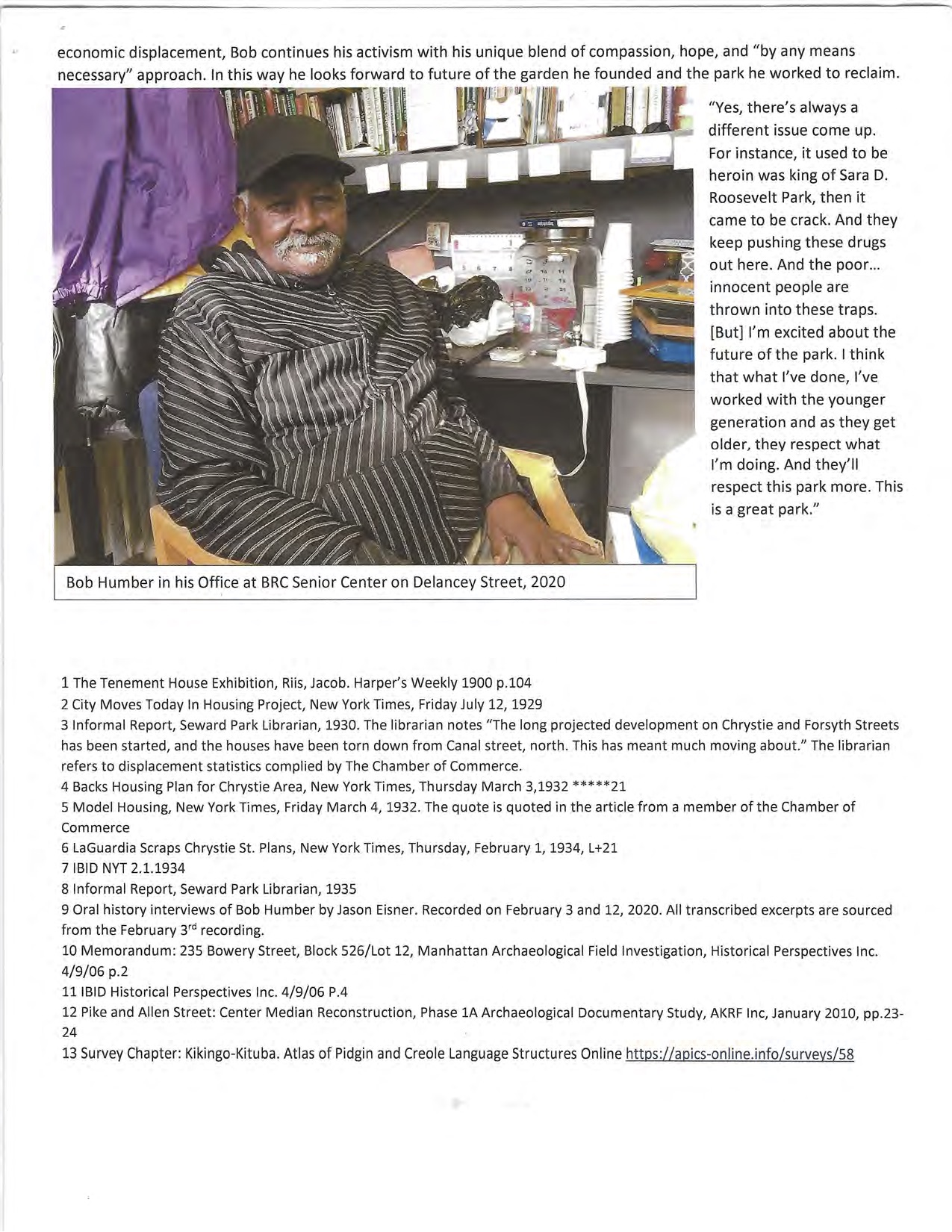
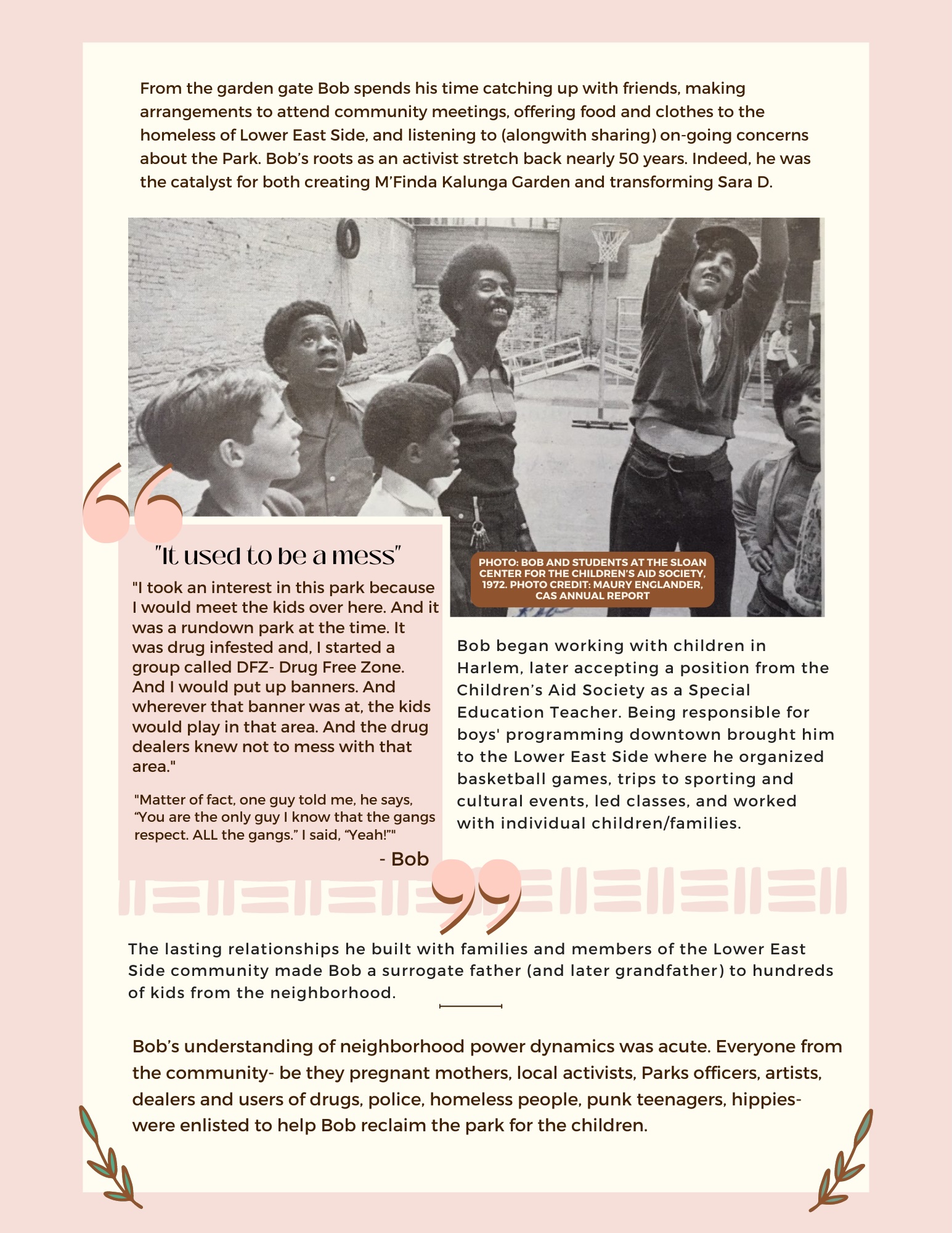
He fought to get the drugs out of Sara Roosevelt Park in the early years of the late 70’s and early 80’s. He and other neighbors joined together to change the way things were done here. He risked his life on bike patrol through pimps and drug dealers to make the park safe for children. He started and taught leagues for children in the neighborhood. Many here call him “dad” because he raised them out of hard times. His decency, firm and loving guidance making all the difference to how a life turned out. He stayed and fought for a good community. And though he lost some battles, he won the day.
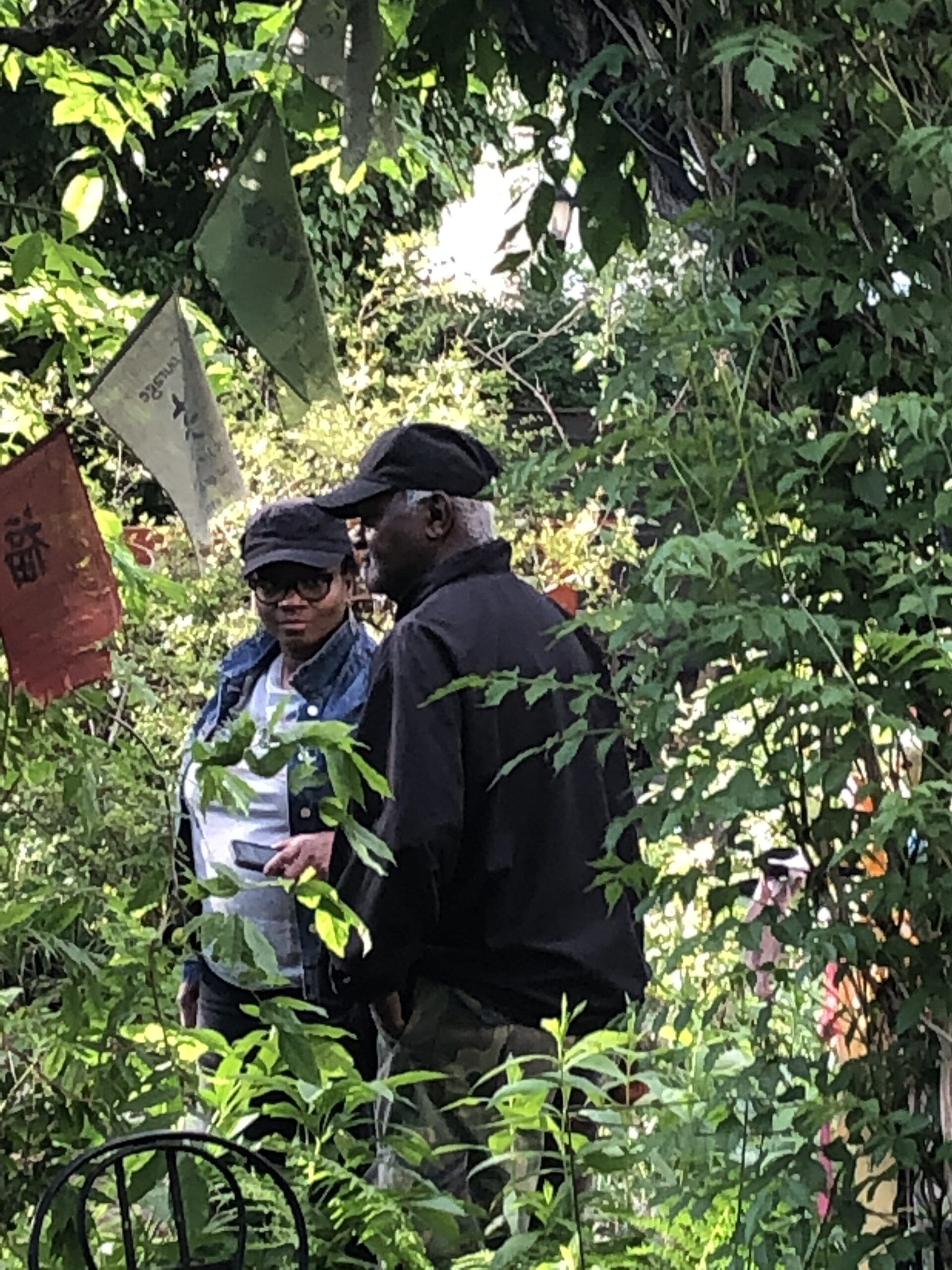
M’Finda Kalunga Garden is an oasis in a deceptively tough neighborhood. Though it continues to attract a higher income bracket, he fights for the people who were here long before it felt cool or safe to others. He welcomes everyone though: rich and poor, all colors and languages, ages and genders.
He has won awards like The Scott Give Back to Grow Urban Gardener of the Year. He has his picture taken with several NYC Mayors and has the respect and friendship with Parks Department Commissioner’s Benepe (NYC) and Castro (Manhattan).
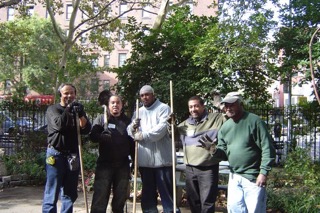
He runs senior gardening classes for the adjoining BRC low income nutrition center, helps young men get started in gardening, teaches young people about the history of this place and a sense of their own belonging here. He is the single most known gardener because he is always here. Bringing in new people, his only requirement is that you pitch in. Many of us gardeners are here today because he asked, “could you give me a hand with this?” We were hooked.
I hope this evening gives Bob some small sense of the gratitude we have for all he has done, but most of all for the friendship he has offered. It is the most beautiful flower in the garden.
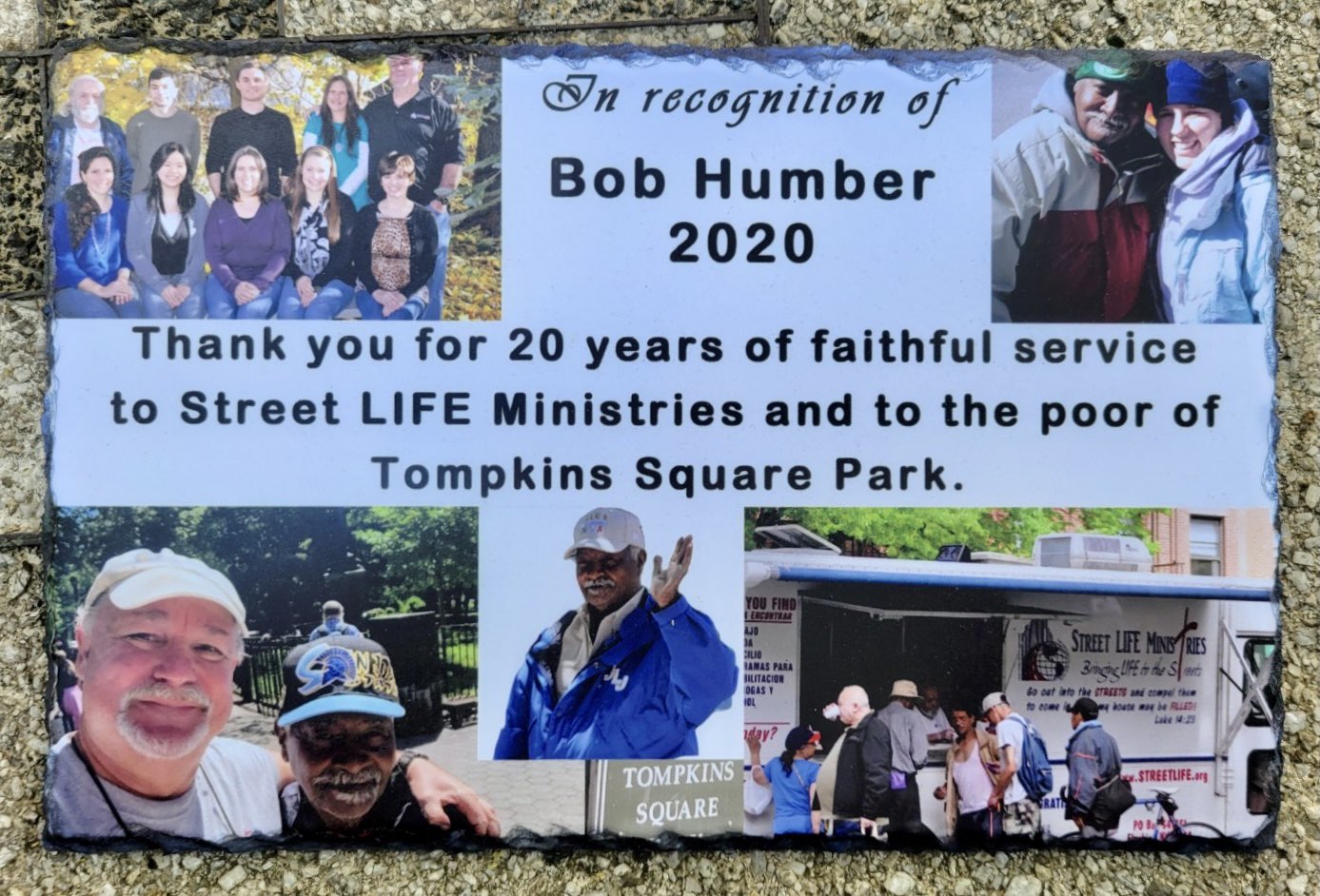


NYPD 5th Pct April 30, 2021
Sergeant Chris KaKit Yip, New York City Police Department, 19 Elizabeth street, NY, NY 10013 #NYPD?4theKids
5th Pct Sgt Yip Facebook posting:
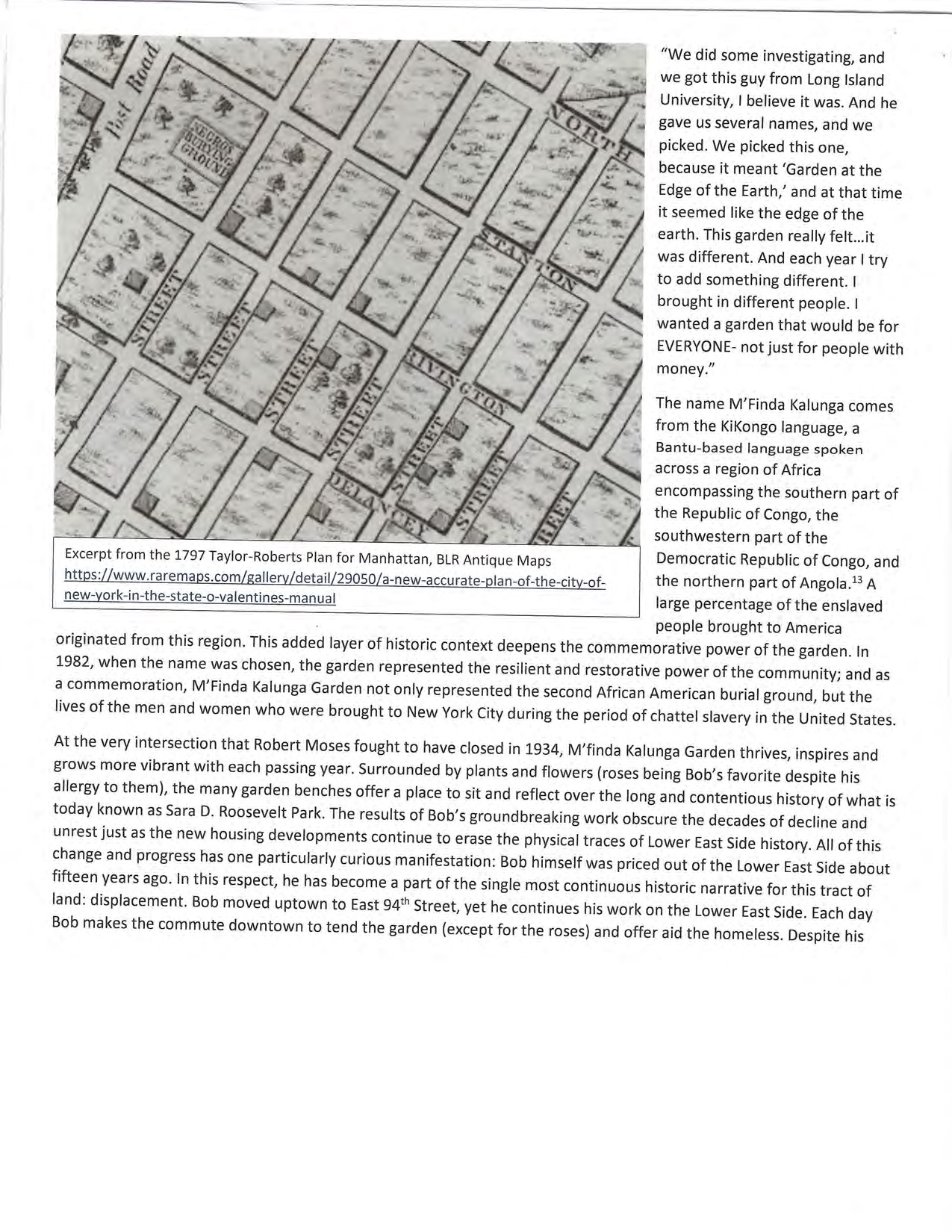
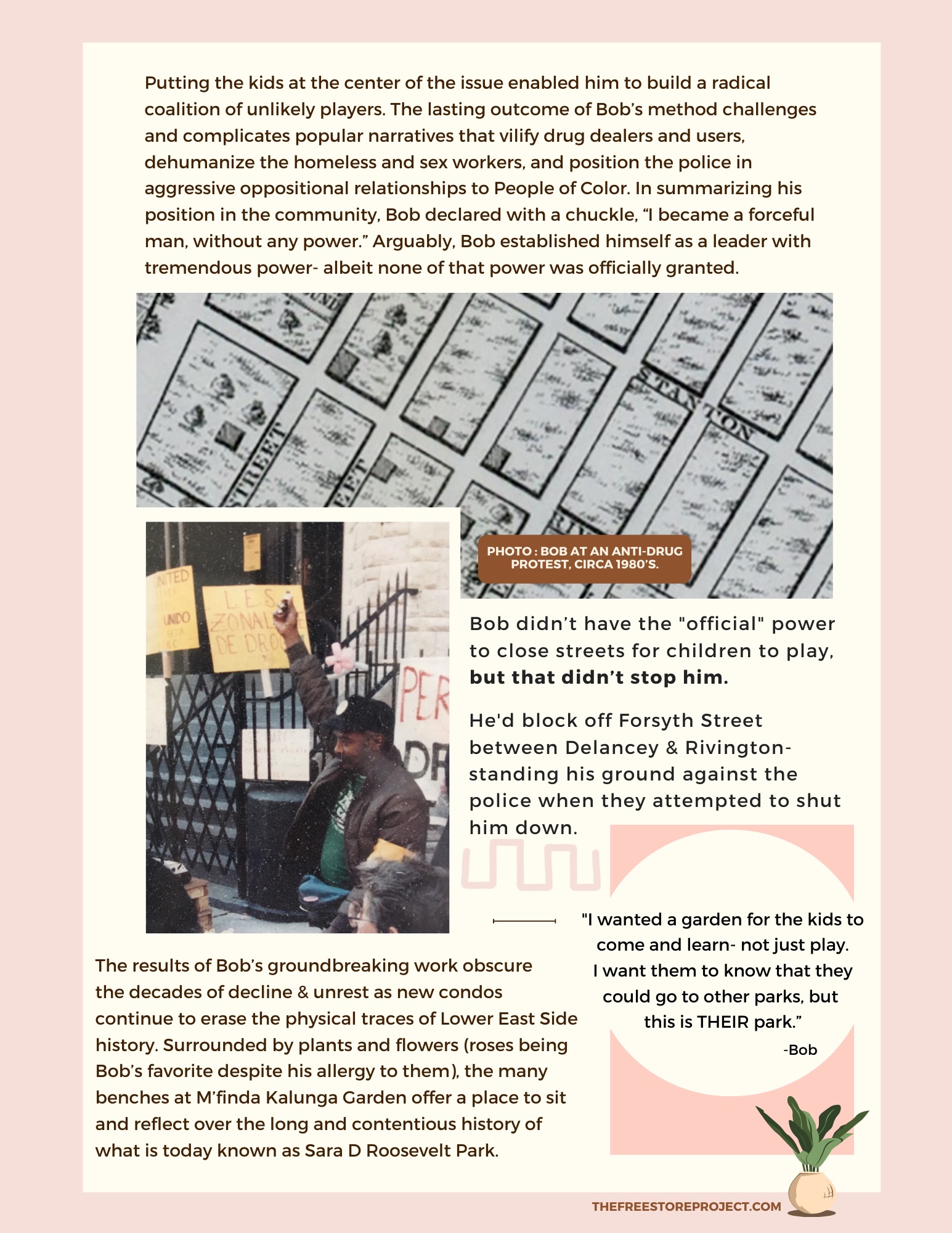
Founded in 1983, the M’Finda Kalunga Garden became Bob’s base for his daily operation with the Park Coalition. He recalls, there was a professor from a university in Long Island who coined the garden its name. M’Finda Kalunga Garden means “Garden at the Edge of the Other Side of the World” in the Kikongo language. It is named in memory of the “second” African American burial ground that was located nearby.
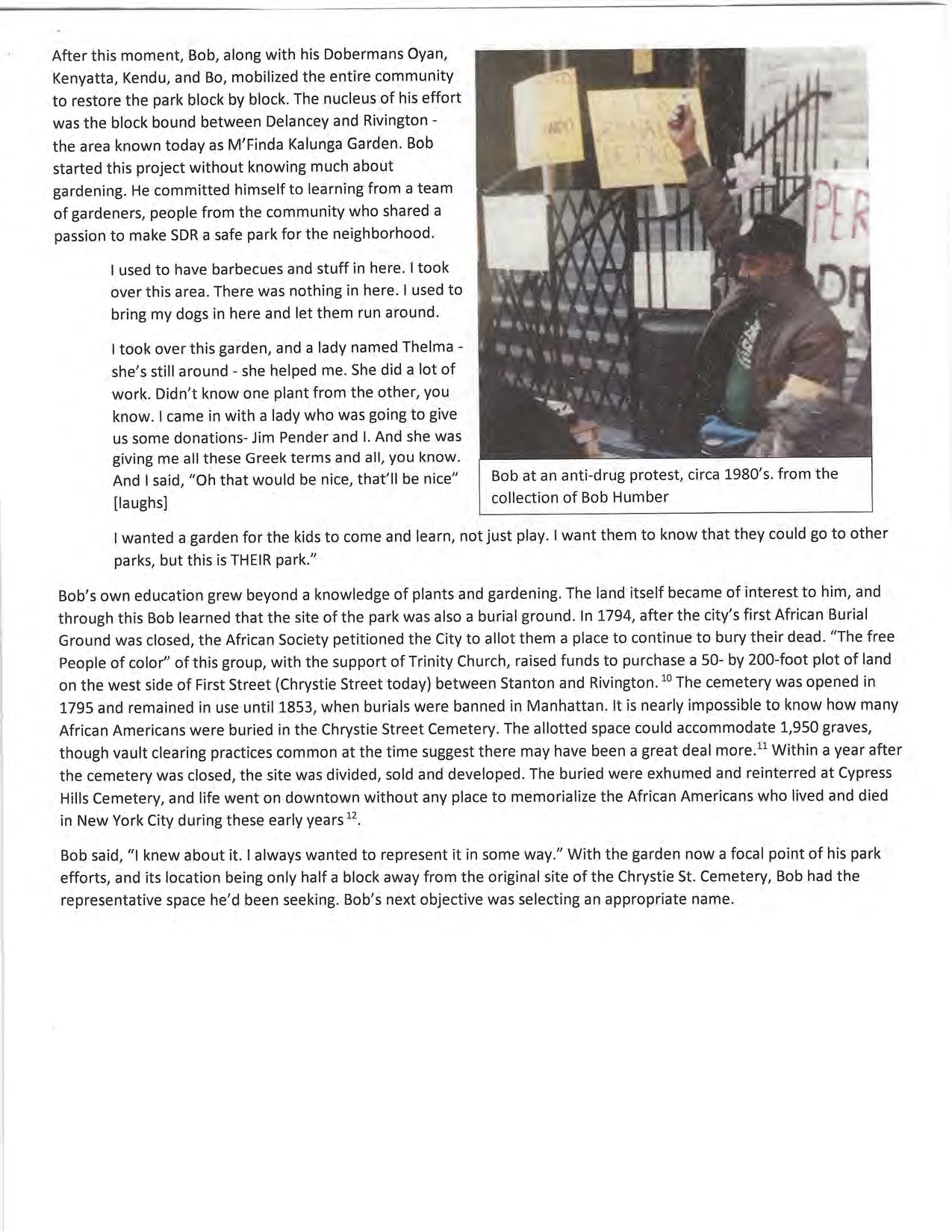
In addition to his bicycle patrol, Bob and his team made signs that read “DFZ” for drug free zone and posted them in the park, in hopes that it would act as a deterrent. He described that the NYPD had officers on bicycles and officers from Mounted unit riding their horses in the park. He added there were even helicopters hovering above at times. Bob also learned that the NYPD would send a cop or two whenever there was an event in the park. So, he made sure there was an event once a week. (See photo of the LB Band. Drummers who are visually impaired performing inside the garden.)
Bob said that drug dealings was so rampant and notorious in the park that there were celebrities who drove to the area, parked a few blocks away and walked to get their fix. Bob also recalled that this one time he had to chaperone a group of young people on a trip to the Yankee stadium and he needed $200. He approached a drug dealer and to his surprise, the drug dealer gave him $500 which he ended up spending it all on the kids.
Bob described the area around the park as being very diverse even back in the 70s and 80s. Mostly Italians, Chinese, and Jews, amongst others. But he also said that children never wanted to do anything with the police. He then saw a change, when officers started playing with them in the park because it was becoming more and more safe. He was impressed.
Sgt Yip and the 5th Precinct highlighted Bob’s work in their campaign to thank neighborhood changers.
Facebook https://www.facebook.com/100068801034927/posts/2635536320077253/
Twitter https://twitter.com/Bowerygals/status/1388996024664879106


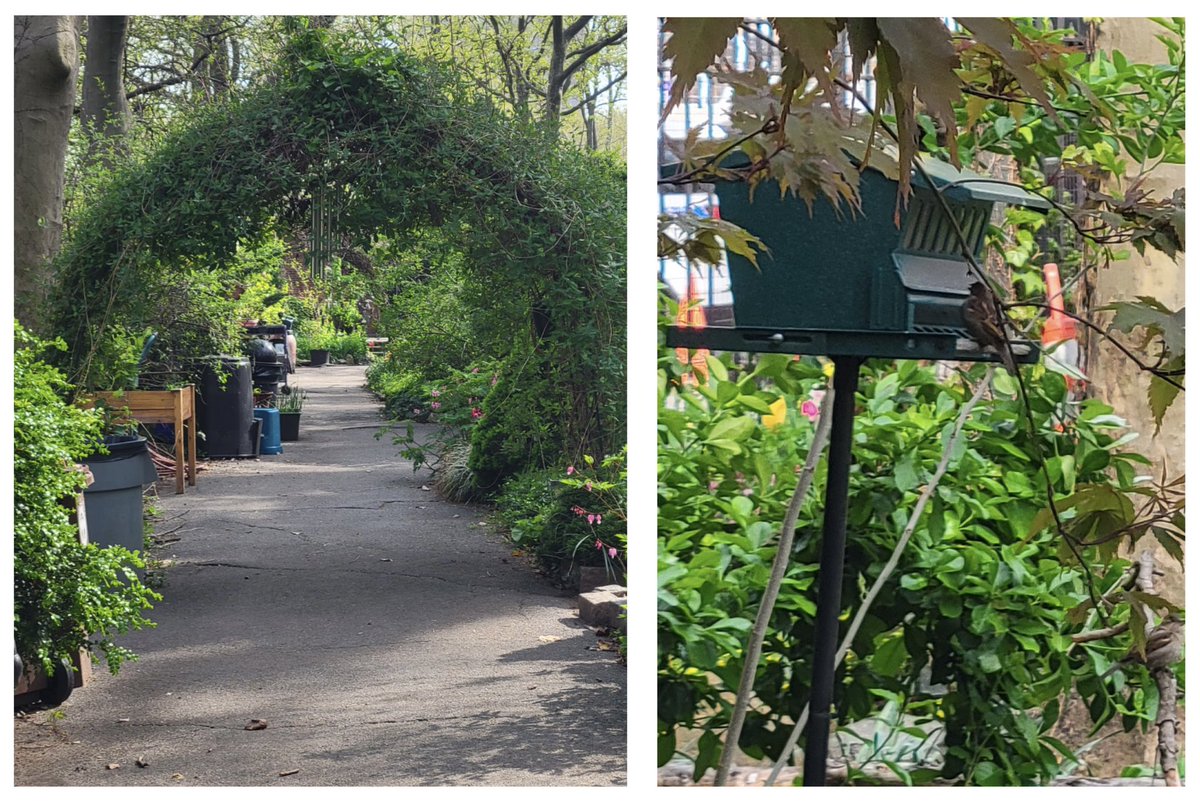


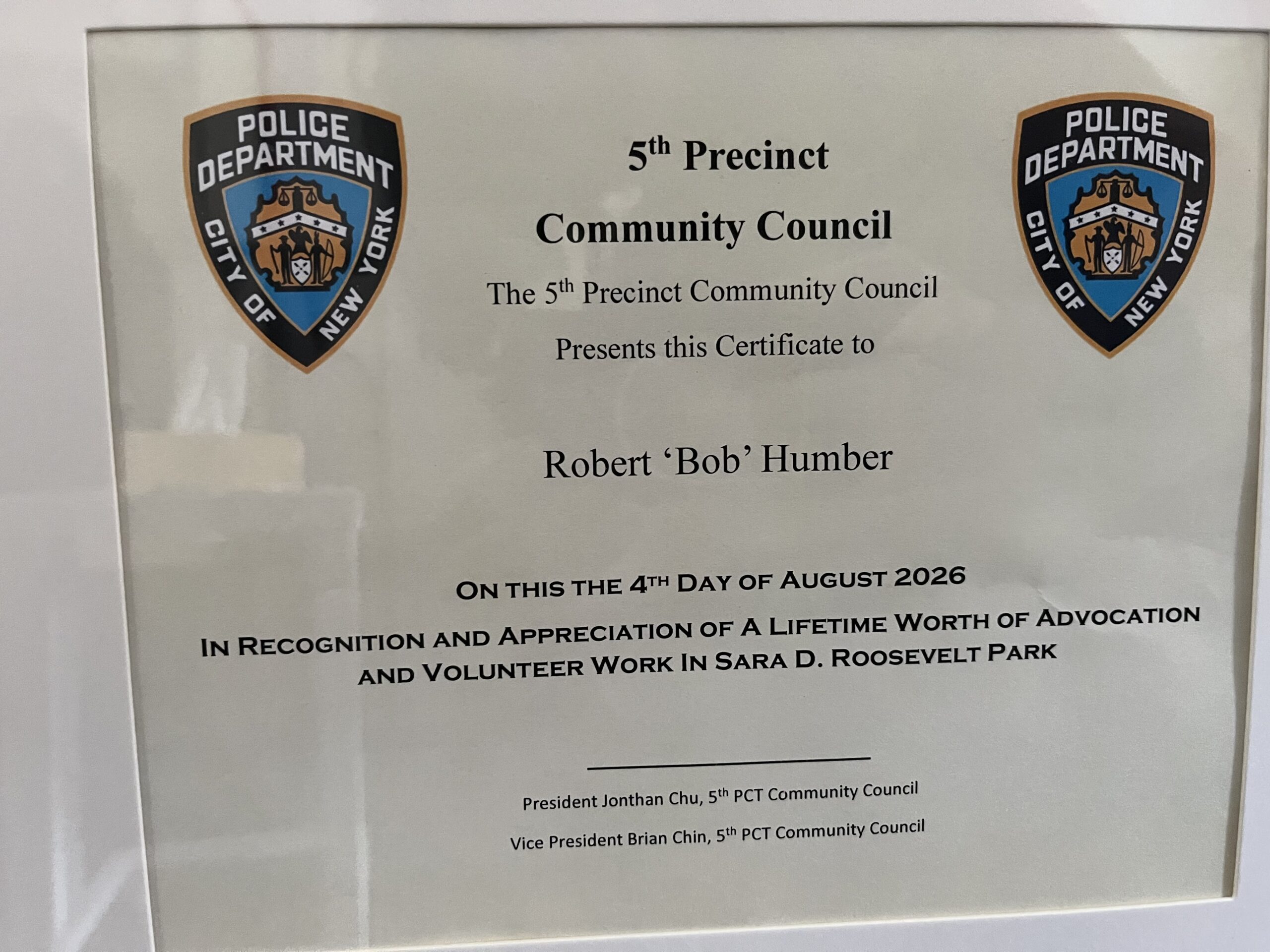
5th Pct National Night Out August 4, 2026


On a section of broken, hazardous asphalt in 1982, Bob Humber developed a plan to create the M’Finda Kalunga Garden in Sara Roosevelt Park. It is now an oasis in the neighborhood. He orchestrated naming the garden after the African Burial Ground located nearby. The idea of the garden started to grow from the neighborhood’s decision in the late 70’s and early 80’s to join together and ride bike patrols through pimps and drug dealers to make the park safe. Bob started and taught leagues for children in those days. Many here call him “dad” because he raised them out of hard times. His decency, firm and loving guidance made all the difference to how a life turned out. He has stayed and continued to fight for this garden and this community.
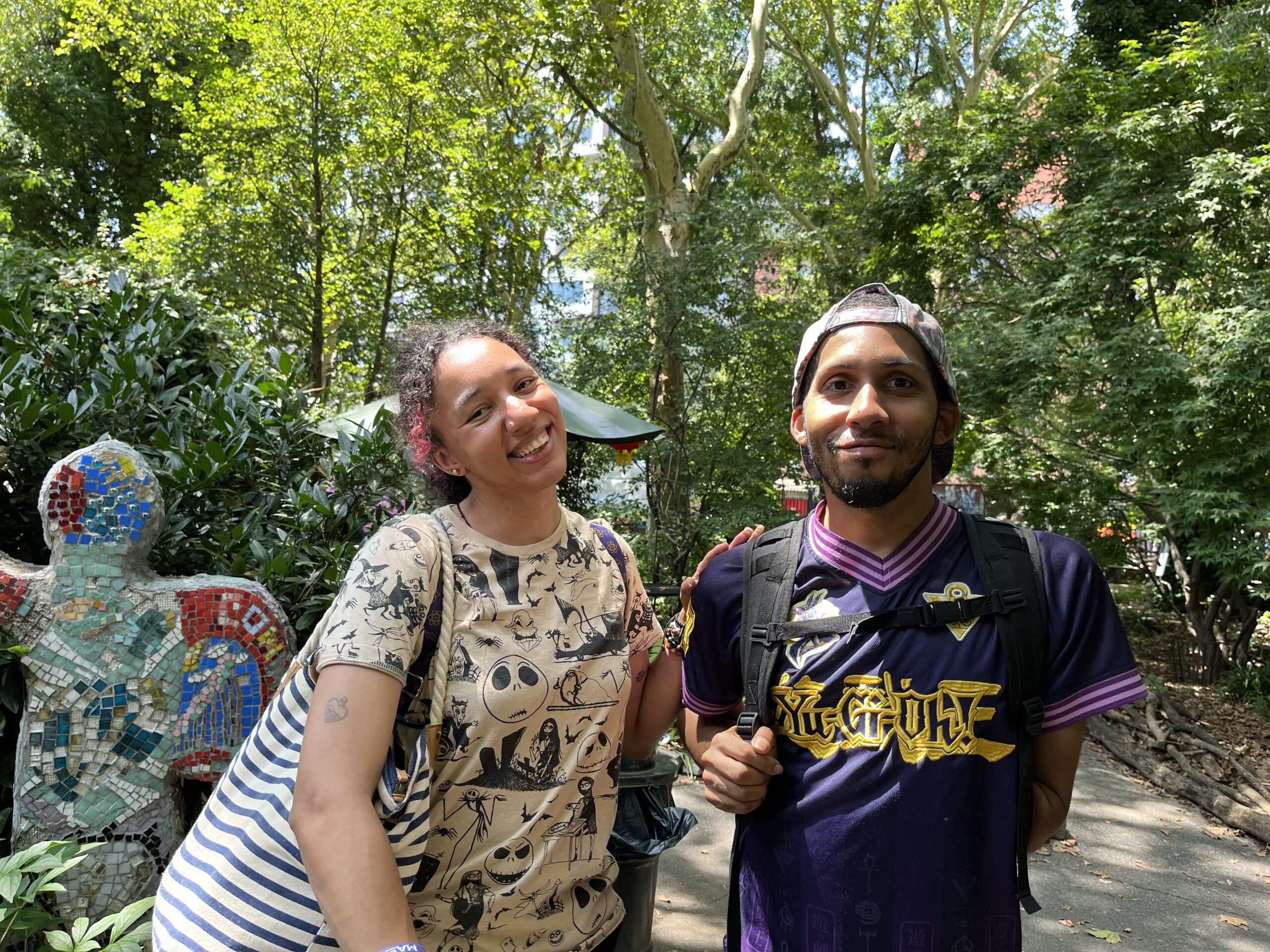
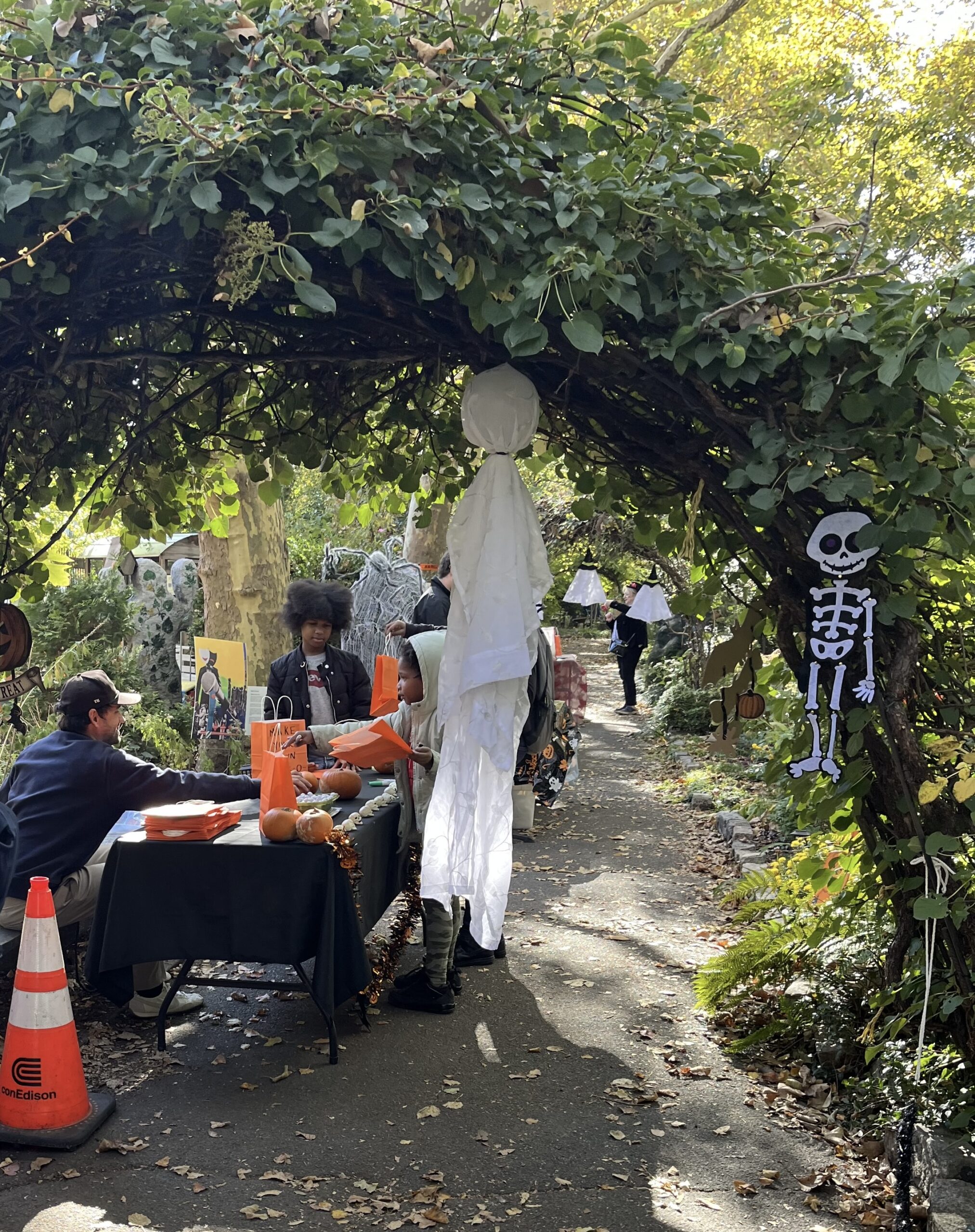
Children, parents and neighbors continue to pitch-in to maintain the garden (which also functions as a senior protected space during weekdays). A diverse neighborhood gathers periodically to celebrate together: Sukkot, Moon Festival, Saimhan/Halloween and Juneteenth. Story hours, IMP Days, a CSA, ladybug releases, fireflies on the 4th of July, turtles, chickens and a local junior high’s mosaics all grace the garden, while other schools volunteer to maintain it. Children have their own area where they have free reign to play, dig in the “dirt pit”, jump in mud, plant flowers, and learn to care for the environment around them.
The M’Finda Kalunga garden is a safe haven where visitors can find a bit of peace while Bob, at 85, continues to stand guard. He still mentors young people. He still guides recovering drug users and homeless men to help care for the garden. He still does the daily work of anchoring our care of the place. And he still lovingly and joyfully designs new flowering areas. And, he welcomes everyone: rich and poor, all colors, languages, and ages. I’ll end with the Pope because it describes what Bob has managed to pull off: “..How inseparable the bond is between concern for nature, justice for the poor, commitment to society, and interior peace.”
K Webster and the Sara Roosevelt Park Community Coalition
Bob Humber – Scotts Urban Greenup Gardener of the Year


Tenement Museum’s Jason Eisner Oral Interviews with Bob Humber
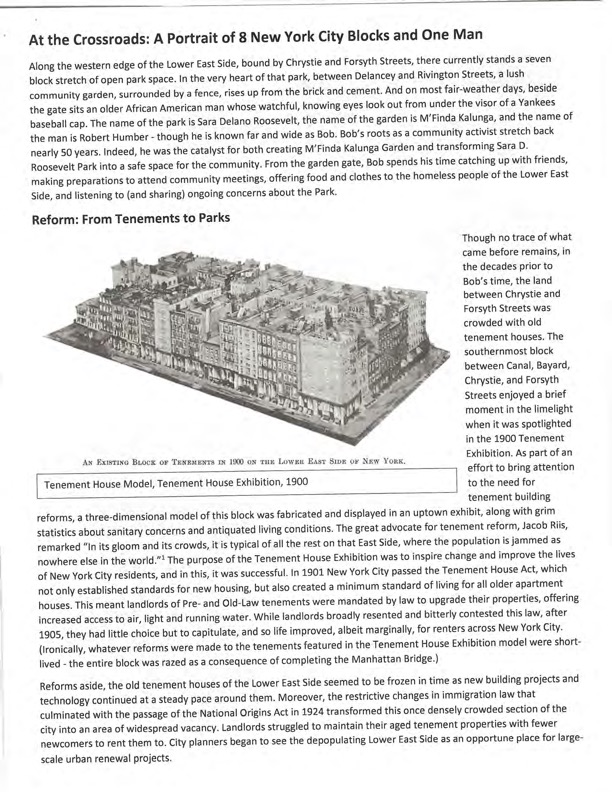
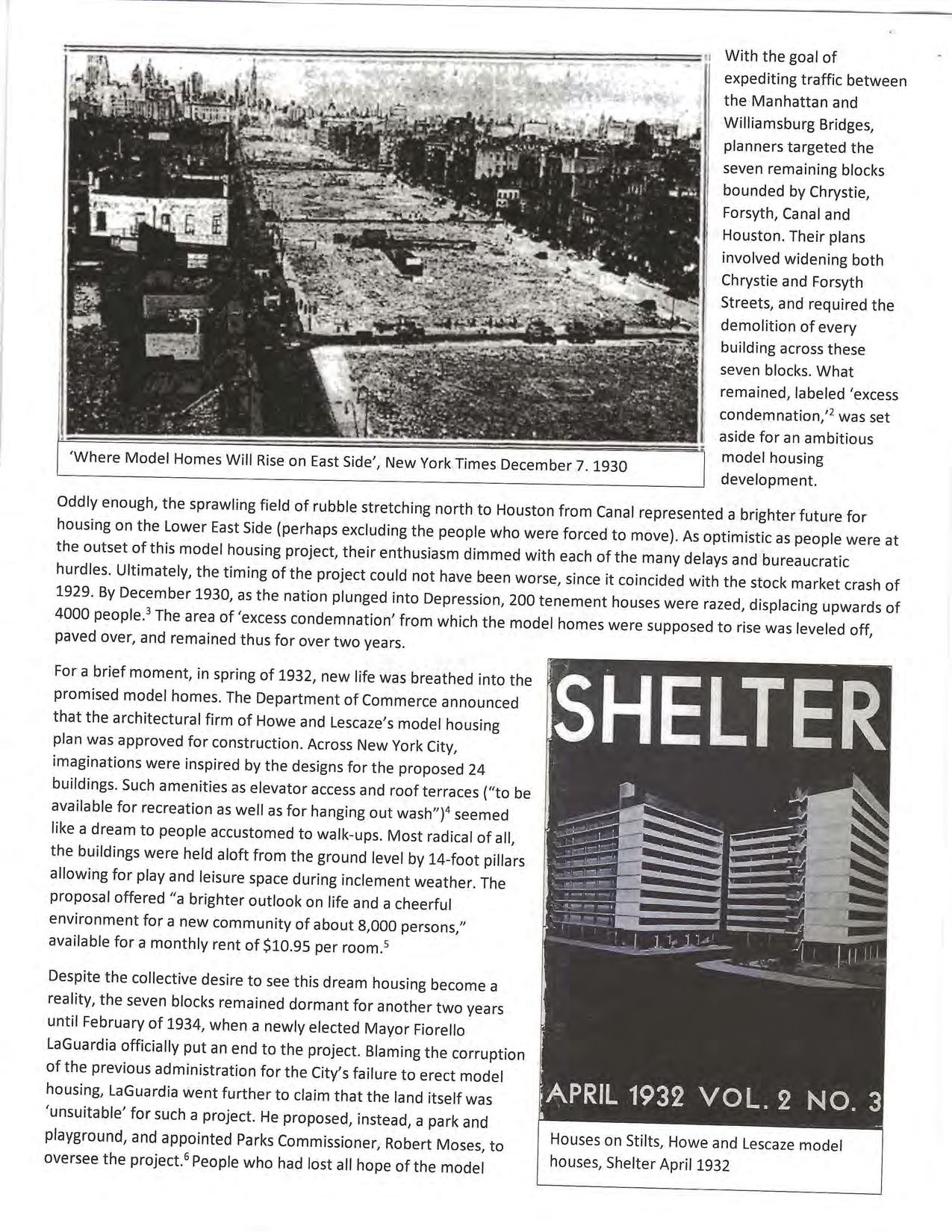
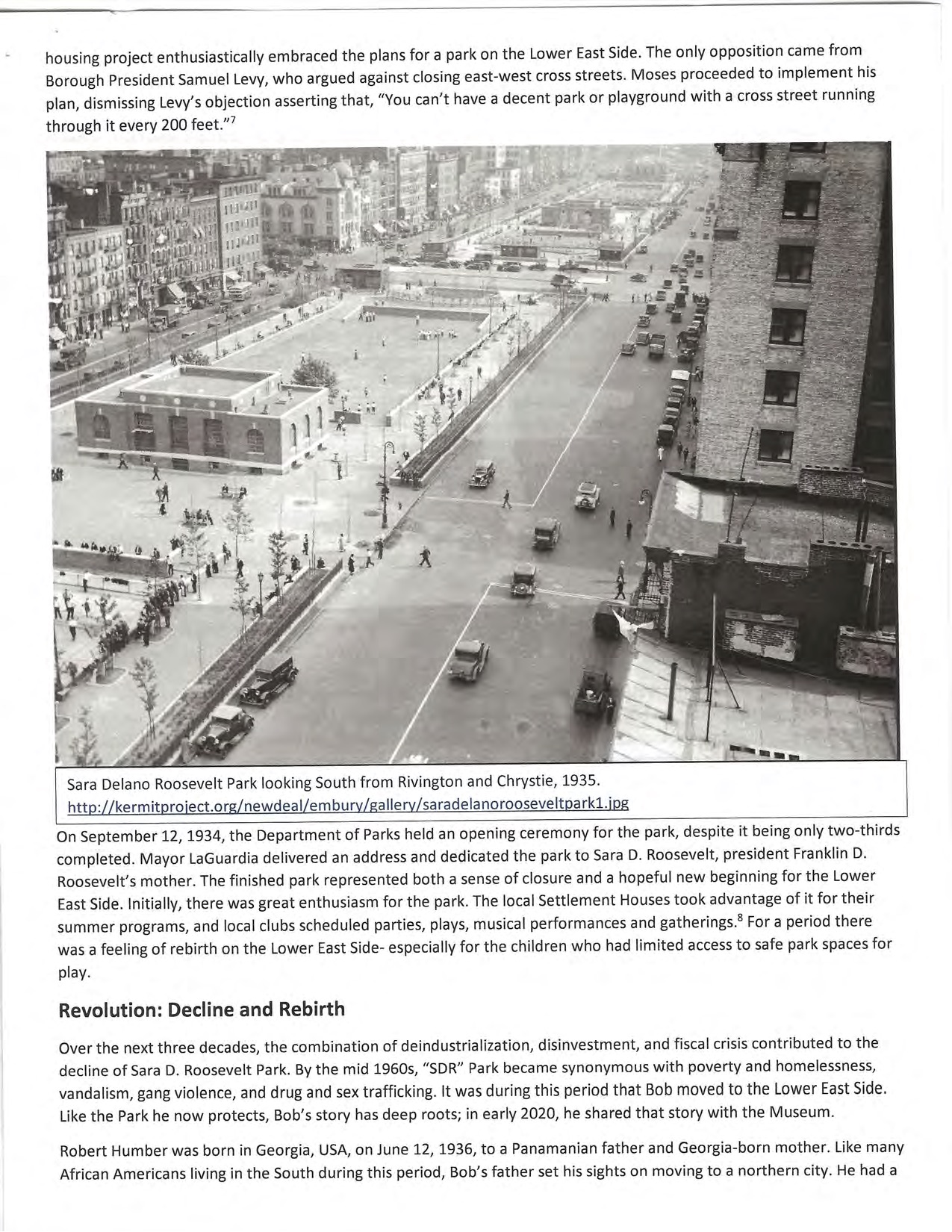
Free Store Advocate Myles Smutney: Tribute to Bob Humber
DNAinfo: Community Garden Offers LES Homeless a Welcome Oasis
By Serena Solomon July 6, 2013
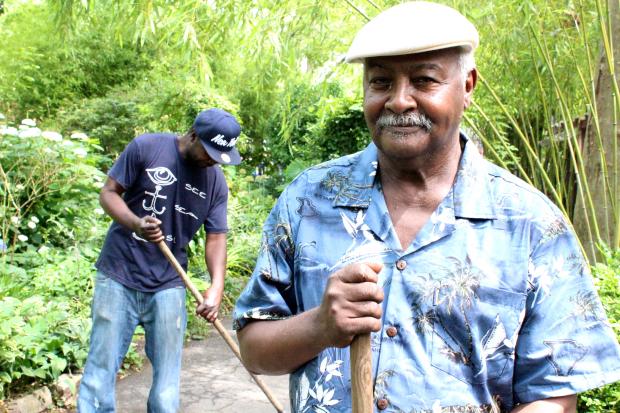
M’Finda Kalunga Community Garden to the oasis inside its fence began when he met head gardener Bob Humber.
“I introduced myself and after that I tell him, ‘I’m home,'” said Camara, a 34-year-old homeless man who frequents Sara D. Roosevelt Park, near the community garden at Delancey and Chrystie streets.
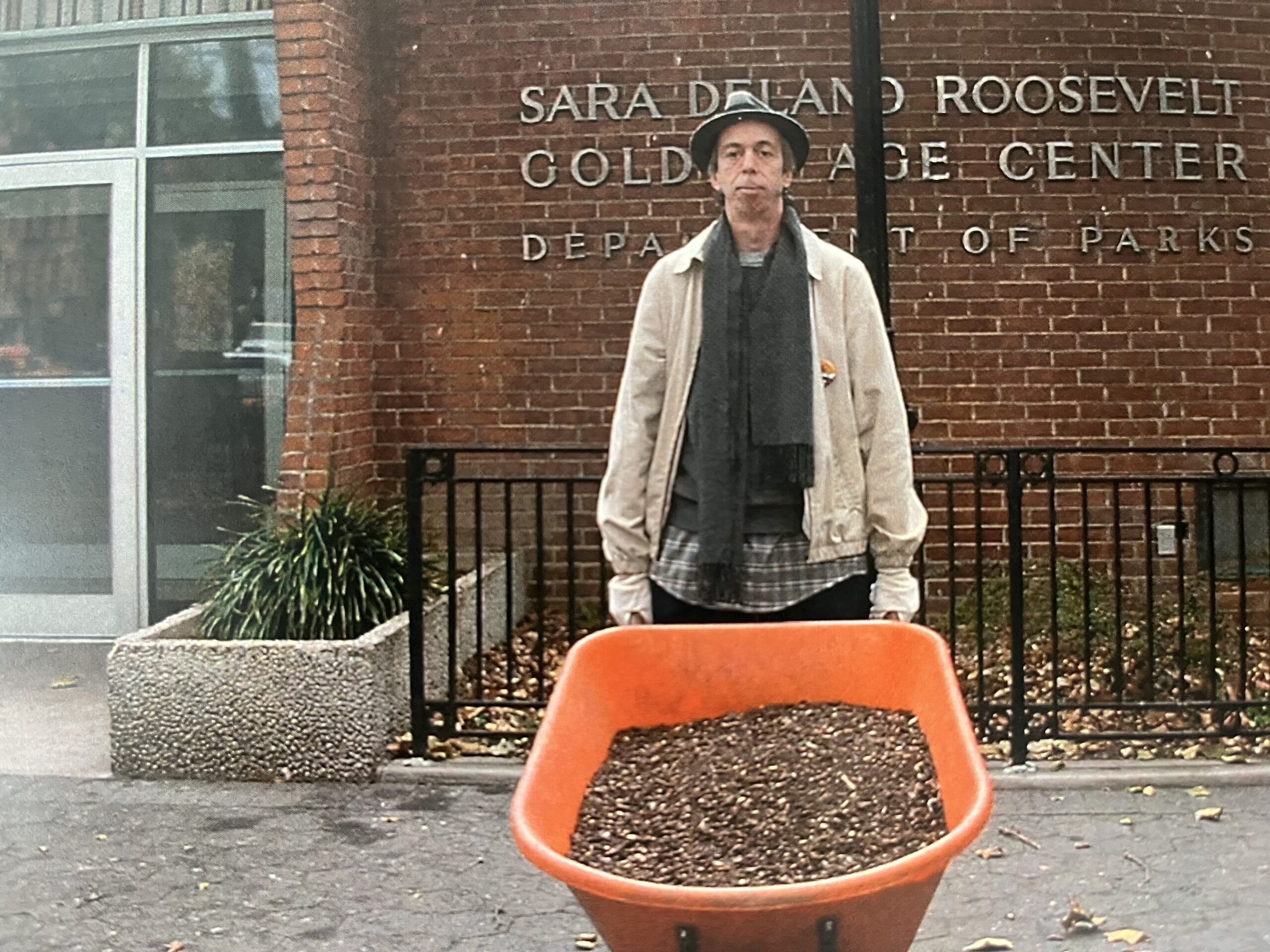
Camara is one of the countless men and women that Humber, 76, a retired community educator with the Children’s Aid Society, is helping to overcome demons — in part by putting them to work in M’Finda Kalunga.
“I ask them if they want to help me because that gives them a lot of value — to help,” Humber said.
He and other community members worked to transform Sara D. Roosevelt Park in the 1980s from an overgrown park that had become a haven for drug use and crime into an urban gem.
“There was nothing in the park, just weeds,” he told DNAinfo New York. “This was a park that people walked through very quickly.”
“It’s my life. It’s who I am. This is what I do,” added Humber, of his retirement days spent tending the garden and taking disenfranchised young people under his wing.
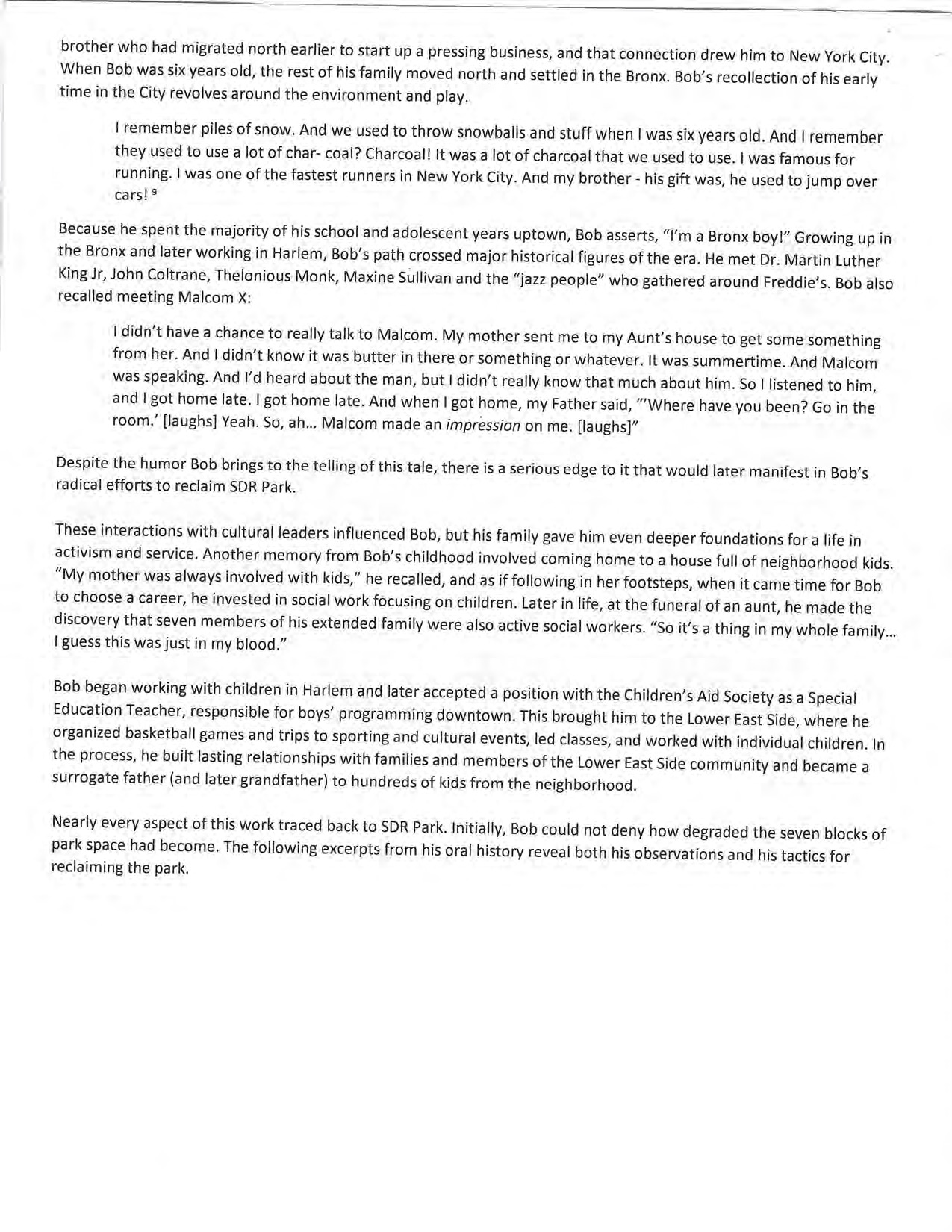
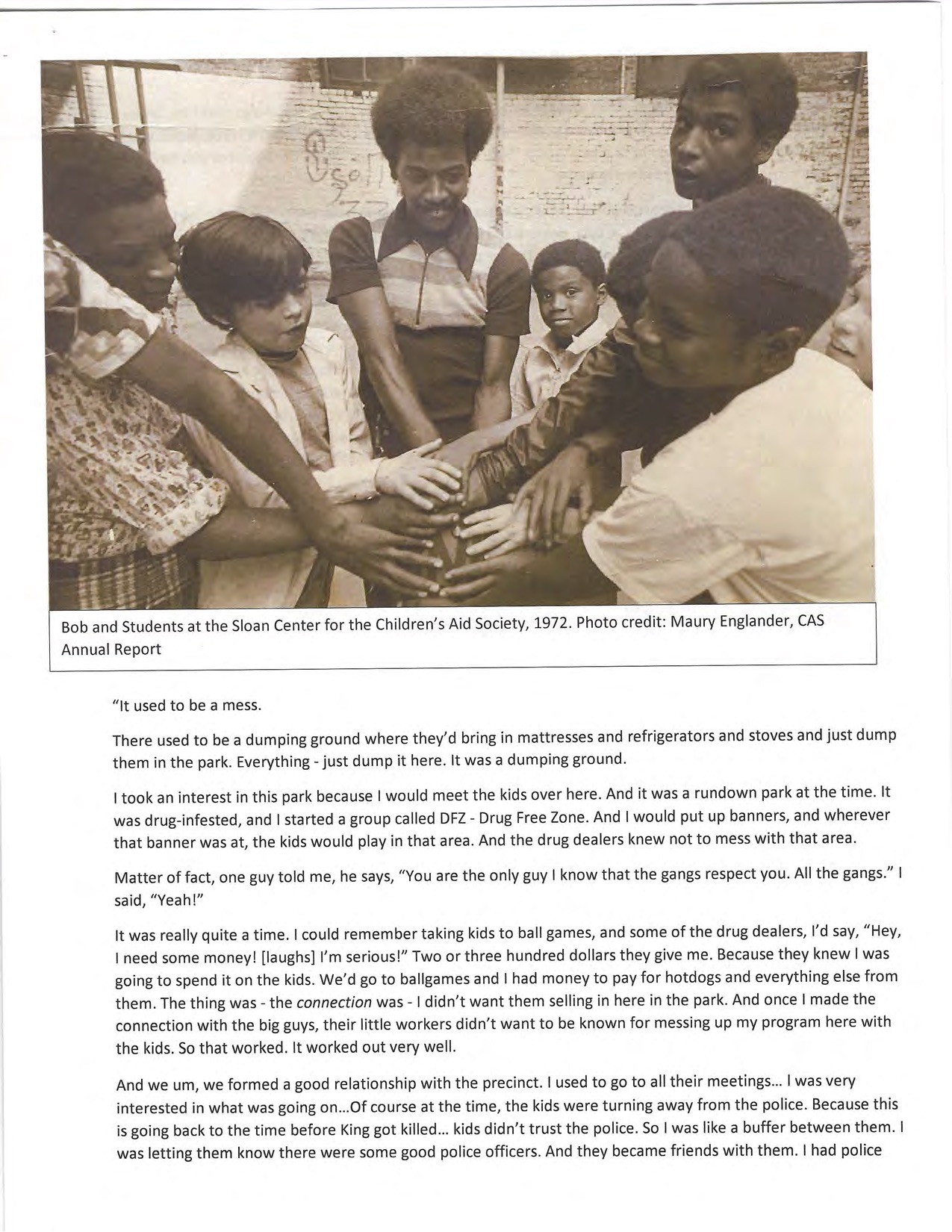
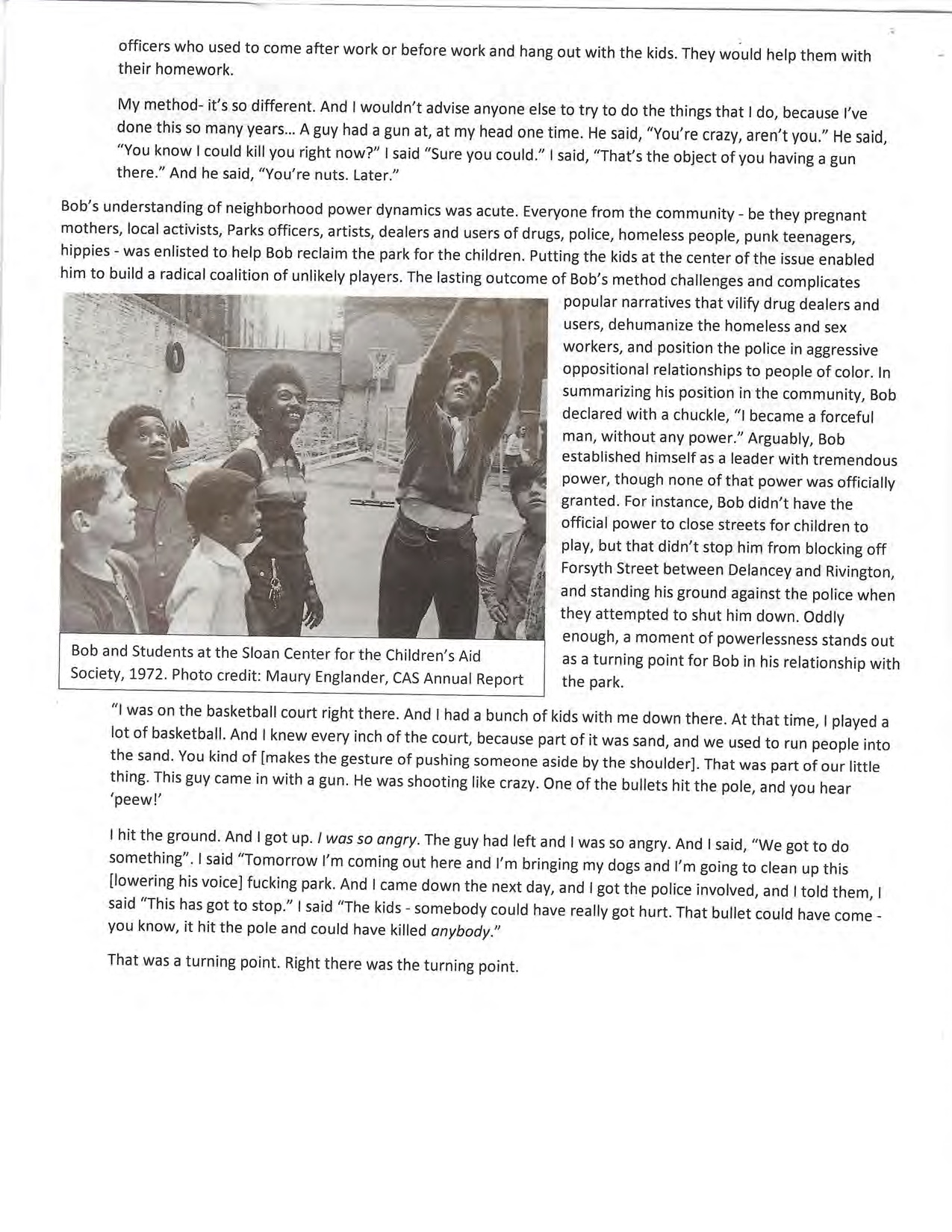
In the 1980s, basketball was a popular tool to involve the homeless teenagers and young adults who spent time in the park, Humber said. But not everyone was interested in basketball, so Humber, with no prior experience in gardening, began teaching visitors to grow plants.
“We turned the park around,” he said of the work that also involved mentoring young people, referring them to nearby services and giving them clothes donated by neighborhood residents.
City Comptroller John Liu has also worked with Humber for many years and called him “the definition of a community activist.”
“Bob Humber likes to say the M’Finda Kalunga Garden brings the community together,” Liu said. “That is certainly true, but it wouldn’t be so if not for his unflinching persistence in weeding out the riff-raff, drug dealers, and trouble makers.”
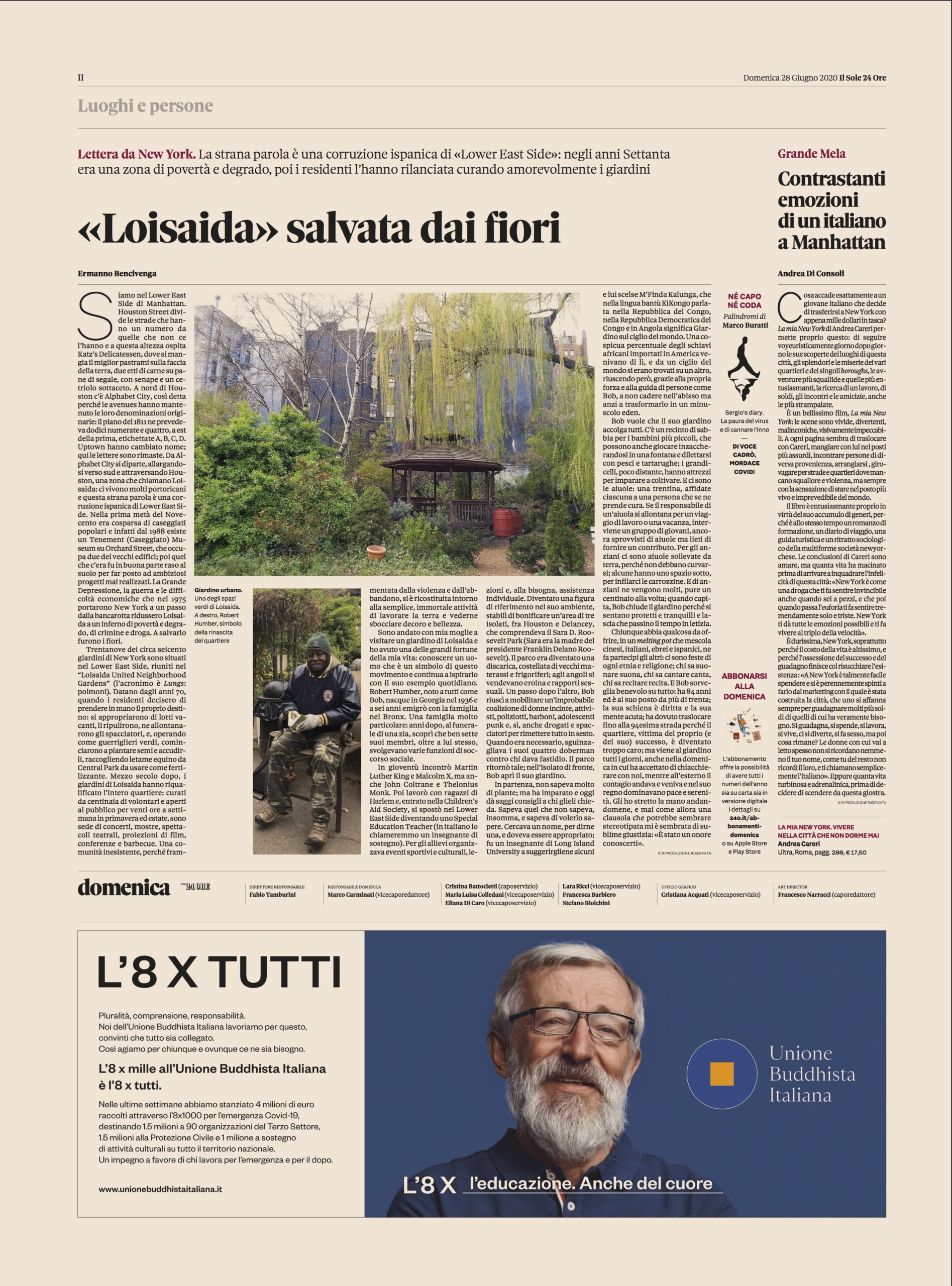
Translation from the Italian:
«Loisaida» saved by flowers!
This strange word is a Hispanic corruption of “Lower East Side”: in the seventies it was an area of poverty and degradation, then the residents relaunched it by lovingly caring for the gardens.!
We are on the Lower East Side of Manhattan. Houston Street divides the streets that have a number from those that do not have it and it houses Katz’s Delicatessen, where you can eat the best pastrami on the face of the earth, two ounces of meat on rye bread, with mustard and a pickled cucumber. North of Houston you find Alphabet City, so called because the avenues have kept their original names: the plan of 1811 included twelve identified by numbers and four, east of the first, labeled A, B, C, D. Uptown the avenues have changed their names; here the letters remained. From Alphabet City, extending southwards and passing through Houston, departs an area called Loisaida: many Puerto Ricans live there and this strange word is a Hispanic corruption of the term Lower East Side. In the first half of the twentieth century it was sprinkled with blocks of public housing and, in fact since 1988, there has been a Tenement Museum on Orchard Street, which occupies two of its old buildings; then what was there was largely demolished to make way for ambitious projects never completed. The Great Depression, the war and the economic difficulties that brought New York one step closer to bankruptcy in 1975 reduced Loisaida to a hell of poverty and degradation, of crime and drugs. What saved it was the flowers.! Thirty-nine of the approximately six hundred New York gardens are located on the Lower East Side, gathered in the “Loisaida United Neighborhood Gardens” (the acronym is Lungs). They date back to the 70s, when the residents decided to take their fate into their own hands: they appropriated vacant plots, cleaned them up, pushed the dealers away, and, operating as green guerrillas, they began to plant seeds and take care of them, collecting horse manure from Central Park for use as a fertilizer. Half a century later, Loisaida gardens have redeveloped the entire neighborhood: cared for by hundreds of volunteers and open to the public for twenty hours a week in spring and summer, they are home to concerts, exhibitions, theatrical performances, film projections, conferences and barbecues. A non-existent community, because fragmented by violence and abandonment, was created around the simple, immortal activity of working the land and seeing its decoration and beauty blossom.!!
I went to visit a garden in Loisaida with my wife and I had one of the luckiest experiences of my life: I met a man who is a symbol of this movement and continues to inspire with his daily example. Robert Humber, known to all as Bob, was born in Georgia in 1936 and at the age of six he emigrated with his family to the Bronx. A very special family: years later, at the funeral of an aunt, he discovered that as many as seven of its members, in addition to him, were involved with various types of social assistance.!In his youth he had met Martin Luther King and Malcolm X, but also John Coltrane and Thelonius Monk. Then he worked with boys in Harlem and, having entered the Children’s Aid Society, he moved to the Lower East Side to become a Special Education Teacher. For the students he organized sporting and cultural events, lessons and, if necessary, individual assistance. Having become a point of reference in the neighborhood, he decided to clean up an area of three blocks between Houston and Delancey, which included Sara D. Rovelevt Park (Sara was the mother of President Franklin Delano Roosevelt). The park had become a landfill, dotted with old mattresses and refrigerators; while heroin and sexual intercourse were sold in the corners. One step at the time, Bob managed to mobilize an unlikely coalition of pregnant women, activists, policemen, bums, punk teenagers and, yes, even drug addicts and drug dealers to get everything back on track. When necessary, he unleashed his four Dobermans against those who interfered. The park returned as such and, on the opposite block, Bob opened his garden.! At the beginning he didn’t know much about plants, but he learned and today he gives wise advice to those who ask him for help. In short, he knew what he didn’t know, and he knew that he wanted to learn. He was looking for a name, for instance, and it had to be appropriate. A Long Island University teacher suggested a few, and Bob chose M’Finda Kalunga, who in the Bantu language KiKongo spoken in the Republic of the Congo, in the Democratic Republic of the Congo and in Angola means Garden on the edge of the world. A large percentage of African slaves in America came from there, and from one edge of the world they had found themselves on another, but managed, thanks to their strength and the guidance of people like Bob, not to fall into the abyss but indeed to turn it into a tiny eden.!
Bob wants his garden to welcome everyone. There is a sandpit for younger children, who can also play by splashing around in a fountain and admiring fish and turtles. Nearby the little ones have tools to learn how to cultivate. And there are the plots: about thirty, each given to a person to care. If the person in charge leaves for a business trip or a holiday, a group of young people intervene, stillwithout plots but happy to make a contribution. For the elderly there are flower beds raised above the ground, so that they do not have to bend; some have a space underneath for wheelchairs. And many old people come, even a hundred at a time; when it happens, Bob closes the garden to make them feel protected and let them enjoy their time.! Anyone with something to offer, in a melting pot of Chinese, Italian, Jewish and Spanish, includes the others: celebrations of all ethnicities and religions take place here; those who can play play, those who can sing sing, those who can act act. And Bob watches over everything benevolently: he is 84 years old and this has been his place for more than thirty; his back is straight and his mind sharp.
He had to move to 94th Street because the neighborhood, victim of his (and its) success, became too expensive; but he comes to the garden every day, even on the Sunday when he agreed to chat with us, while outside the infection came and went and in his kingdom peace and serenity dominated. I shook his hand as I left, and never before did a clause that might seem stereotyped was to me the sublime truth: “It was an honor to meet you.”!!