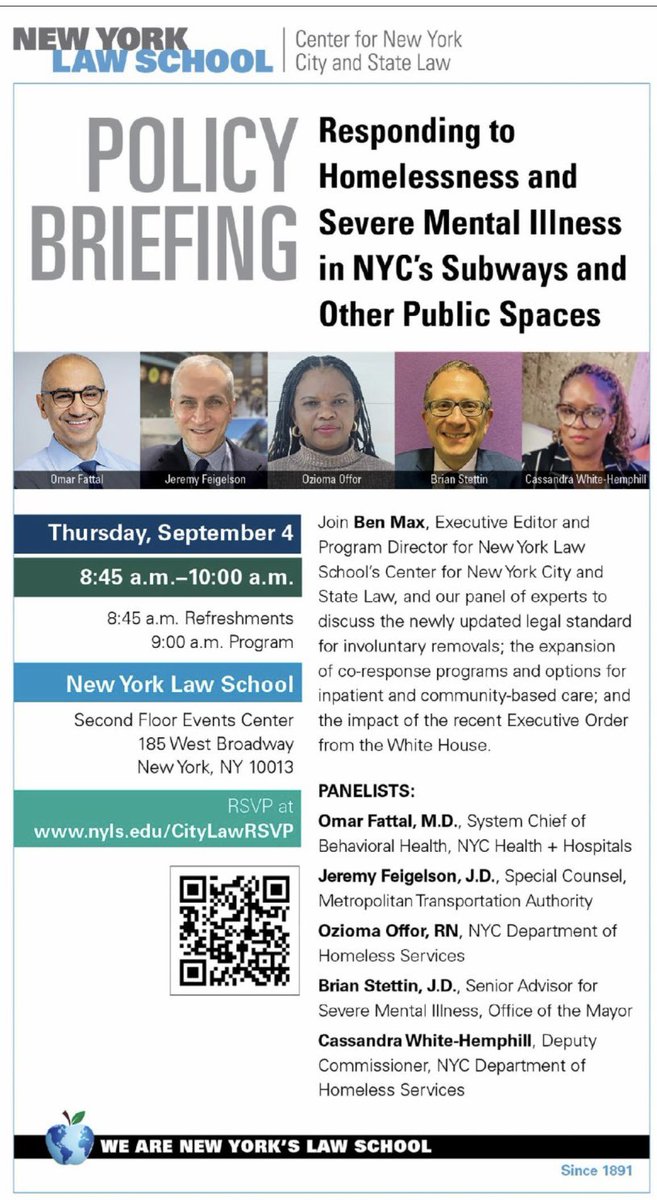
Mayor Forum NY Law School with Ben Max and Center for an Urban Future Panel on the idea of Concessions as Funding Source for NYC Parks. A Few Concerns

Mayoral Forum on Parks

photo NY4Parks

We heard from candidates running for New York City Mayor ahead of the June primary election. 10 Democratic candidates have been invited based on their prominence, polling, and fundraising. Most are expected to participate.

Moderated by Ben Max, Program Director, NYLS Center for New York City and State Law, with questions directly from Play Fair Coalition members.

This forum is co-hosted by NYLS Center for New York City and State Law and New Yorkers for Parks, with partners from the Play Fair Coalition.

Recording available on Ben Max’s podcast: Mayoral Candidate Forum on Parks, Recreation, & Open Space HERE


On Expanding Concession in NYC’s Parks see Center for an Urban Future

We have a few concerns. Not the least of which is the only Parks groups that weighed in on this panel were Conservancies.

Any move that reads of more privatization of NYC Parks especially in this period is not entirely welcome.

We have a NYC Parks Department – happily would see it funded by funds generated by the Public’s Parks – DIRECTLY. Do we need to go through a non-public non -governmental entity in the midst of watching our government being dismantled?

See CUF recommendations below.

Council Member Shekar Krishnan Chair of NYC Council Parks Committee


Sue Donoghue NYC Parks Commissioner

Panel of Conservancies weigh in.

1. Launch 20 new destination-worthy concessions over the next three years. To realize more of the untapped opportunity to generate concessions revenue in parks, the mayor should launch a major new effort to create 20 destination concessions over the next three years—from new restaurants to year-round spas—that generate maintenance funding while enhancing the experience of parkgoers. A measured expansion of these offerings could help transform underutilized areas of parks into vibrant community hubs and generate as much as $10 million in recurring annual revenue. To jumpstart this effort, the mayor should direct NYC Parks to identify 20 high-potential sites across the five boroughs with community input, prioritize underutilized assets like pool houses and comfort stations for adaptive reuse, and issue RFPs aimed at attracting local entrepreneurs and innovative concessionaires.

2. Designate a trusted partner to capture a greater share of future concessions revenue to reinvest in parks—or amend the City Charter to enable Parks to capture revenue. To ensure that this revenue benefits parks, City Hall should work with NYC Parks to distribute dollars through a trusted nonprofit partner or multiple partners to address the agency’s maintenance and programming needs. The city could also consider creating a new Parks Maintenance Trust or other designated entity that would collect revenue from both new concessions and the renewal of existing license agreements, such as with the stadiums located on parkland. City Hall could also explore an amendment to the City Charter that would enable NYC Parks to hold onto a portion of its revenues over a set target—for instance, all concessions revenue over $50 million. The city could also pilot new efforts to create revenue-sharing agreements with smaller parks organizations including “Friends of” groups.

Importantly, the mayor and City Council should commit to maintaining city tax levy funding at or above a set baseline, so that new revenues are used to benefit parks, not close other budget gaps (this requirement could also be written into the bylaws of a new Parks Maintenance Trust). To ensure that the revenue benefits all parks with unmet maintenance needs, the city should consider an 80-20 revenue split—only for new concessions revenues in parks without existing conservancies—that keeps most of the proceeds in the host park while directing a portion to support green spaces in underserved neighborhoods. Once this system is operational, the City Council could pass legislation requiring NYC Parks to report on how revenue from the Parks Maintenance Trust or similar entity is being allocated.

3. Launch a new Concessions Investment Fund with NYCEDC to renovate and open new concessions in underutilized parks properties. Experts suggest that more than 20 parks properties could provide an opportune setting for a new concession in the future. The pool houses in Astoria Park and Jackie Robinson Park. An abandoned newsstand in Grand Army Plaza. Half-empty maintenance sheds in Sara D. Roosevelt Park and Alley Pond Park. The visitor center in Fort Greene Park. The dilapidated kiosk in Union Square. The bathhouse in Baruch Playground. The Tennis House in Prospect Park. The radio station building in WNYC Transmitter Park. And Worth Square, next to Madison Square Park.

Most of these sites, however, lack the capital investment needed to attract a private sector partner, such as electricity, plumbing, and HVAC—or even a stable structure. Inspired by the renovations of McCarren Parkhouse and the Orchard Beach Pavilion, NYC Parks should launch a new Concessions Investment Fund in partnership with NYCEDC, which could mobilize the upfront capital investment needed to attract private sector investment and help prepare underutilized or empty parks structures to become attractive, revenue-generating concessions.

The agencies could also consider the option of a low-interest revolving loan fund, providing concessionaires with a source of affordable capital and technical assistance focused on the unique needs and opportunities of parks properties. As an added benefit, if some of the capital work is managed directly by NYCEDC, the process is simplified and can often be accomplished much more quickly and affordably than if it flows through the city’s capital process.

4. Pilot a pop-up parks concession program to expand temporary, mobile, and seasonal opportunities citywide. In addition to creating new destination-worthy concessions, the city has a significant opportunity to develop more concessions that fill the gap between brick-and-mortar establishments and mobile pushcarts. To capture new revenues with lower costs of operation and easier deployment than a full RFP for an existing structure, City Hall should work with NYC Parks to pilot a pop-up concession program to reach more parks citywide. The city could also consider launching an RFP for an operator or coordinator of mobile concessions, coordinating with the hundreds of programs taking place in parks across the city to offer audiences options for food and drink while generating revenue for the host park.

There are examples elsewhere to follow. In Philadelphia, the “Parks on Tap” program sees a beer garden travel to a new park each week for 26 weeks straight from April to October, with a portion of sales going back to Philadelphia Parks & Recreation. In Chicago, the 7323 Café operates out of a storage container in Flying Squirrel Park. And locally, the Queens Night Market, although not technically on parkland, brings a destination-worthy event featuring local entrepreneurs to the edges of Flushing Meadows-Corona Park.

5. Reform citywide concessions guidelines to boost high-quality participation in parks concession RFPs. While much can be done to ensure that NYC Parks can both bolster concessions and hold onto a greater share of their revenue, it should be coupled with a concerted effort from City Hall to align processes around concession agreements to attract a stronger pool of bidders. For decades, too many RFPs have seen a limited response or gone unanswered. In addition, differing agreements among agencies can lead to unintentional competition between concessions located on parkland versus Department of Transportation property or other city-owned assets.

To address these obstacles, the mayor should work with all agencies that license concessions to develop a citywide approach to concessions agreement development and revenue-sharing—applying best practices across agencies, simplifying the process wherever possible, and aligning the terms that agencies offer to maximize concessions quality, feasibility, revenue, and benefits for New Yorkers.

Endnotes

1. These restaurants and cafes are located in city parks that are not managed by conservancies or other nonprofit partner organizations.

2. Center for an Urban Future analysis of data from the Mayor’s Office of Contract Services, 2023.

3. John Surico and Eli Dvorkin, Paying for NYC’s Growing Park Needs, Center for an Urban Future, January 2024, https://nycfuture.org/research/paying-for-nycs-growing-parks-needs

4. Center for an Urban Future analysis of data from the NYC Office of Management and Budget’s annual financial plans and from the NYC Council’s annual reports on the preliminary plan for the Department of Parks and Recreation.

Read MoreMayor Forum NY Law School with Ben Max and Center for an Urban Future Panel on the idea of Concessions as Funding Source for NYC Parks. A Few Concerns
  • Post category:News

ReelAbilities Film Festival with Special Guests Wicked’s Marrisa Bode and Ethan Slater

REELABILILTIES Film Festival NYC

Beautiful Night, beautiful people. All.

Marrisa Bode and Ethan Slater (from Wicked) in full support.


“I’m through with playing by the rules of someone else’s game

Too late for second-guessing

Too late to go back to sleep

It’s time to trust my instincts Close my eyes and leap

It’s time to try defying gravity”

We agree.


Read MoreReelAbilities Film Festival with Special Guests Wicked’s Marrisa Bode and Ethan Slater
  • Post category:News

NYC Housing brings their Affordable Housing Outreach to the BRC in Sara Roosevelt

Thanks to NYC Housing Preservation and Development Team for presenting options for seniors in need of affordable and accessible housing and to the BRC’s Kim Fong and staff for hosting and to the interpreters who insured everything said was understood.

Special Thanks to Ahmed Tigani Acting Commissioner of NYC’s Department of Housing Preservation and Development

and Ilana Maier and William Fowler: Communications

Thank you also to LiveOn NY

This was a vital outreach event for our communities’ elders.

– Applications for affordable senior housing in NYC are over 520,000 and growing.
-We had almost 93,000 homeless New Yorkers in December. 4
– The number of single adults ages 65+ in the city’s main shelter system more than doubled from 2014 to 2022.5
– Poverty rates for older adults: Manhattan 16.3%. AARP
-65% of older New Yorkers surveyed live on less than $15,000 a year. 32% don’t receive social security. One in five older women live below the poverty level”. LiveOnNY


Ahmen Tigani (Acting Commissioner of NYC’s Deptof HPD) and K Webster (Coalition President of Sara Roosevelt Park Community Coalition) in the beautiful M’Finda Kalunga Community Garden (all-volunteer maintained a GreenThumb Garden).

Photos: Ilana Maier

Read MoreNYC Housing brings their Affordable Housing Outreach to the BRC in Sara Roosevelt
  • Post category:News

The Resistance Rangers, a group of more than 700 current and recently fired National Park Service employees, are back with another round of protests. Planned for this coming Saturday, they’re asking folks to show up at a national park sites across America.

“The Resistance Rangers, a group of more than 700 current and recently fired National Park Service employees, are back with another round of protests. Planned for this coming Saturday, they’re asking folks to show up at all 433 national park sites across America.


The invite reads: “You ready for round two?! Protect the Parks Protest is back!” They suggest holding rallies, and “teach-ins” where they say folks can “Teach each other how to contact your reps, then take turns calling. Set up some stations: postcard writing, calling, emailing, etc!”
These amazing current and former park rangers have it right—all of us need to take part in contacting Congress. That’s why we formed our activism arm—The Watchdog Coalition—which has tens of thousands of members who’ve already sent more than 218,000 letters, and made countless calls to the House and Senate.”

The Dworkin Report

Read MoreThe Resistance Rangers, a group of more than 700 current and recently fired National Park Service employees, are back with another round of protests. Planned for this coming Saturday, they’re asking folks to show up at a national park sites across America.
  • Post category:News

From NY4 Parks and PlayFair Coalition

As we approach the Play Fair Rally & Preliminary Budget Hearing on Thursday, March 20, we want to ensure that everyone feels prepared to deliver strong and impactful testimony. To support you, we are offering Testimony Office Hours where you can receive guidance on crafting your remarks, ask questions, and refine your messaging.

? Sign up for a slot here:

Need help preparing your testimony?
View our testimony talking points and testimony script.

Whether you’re testifying for the first time or looking to sharpen your points, we encourage you to take advantage of this opportunity.

Thursday, March 20 – Play Fair Rally & Preliminary Budget Hearing
Rally: 12 PM on City Hall Steps
Budget Hearing: 1 PM in City Hall Committee Room
RSVP for the Rally: bit.ly/ParksRally320
Register to Virtually Testify at the Hearing: Sign Up Here

Note that if you are testifying in person after the rally, you don’t need to pre-register. Your voice is critical in this fight, and we look forward to standing together to make an impact. If you have any questions, feel free to reach out.

March 20!

Read MoreFrom NY4 Parks and PlayFair Coalition
  • Post category:News

Resisting Cultural Erasure: Sharing Black Histories of the LES and Beyond

FABnyc 

In honor of Black History Month, join us for a conversation with

Immanuel Oni, Debra Jeffreys-Glass, Catherine Mbali Green-Johnson and Shanna Sabio!


Resisting Cultural Erasure:
Sharing Black Histories of the LES and Beyond…

Thursday, February 27
6:30pm-8pm, Free

70 E 4th Street, 1st Floor


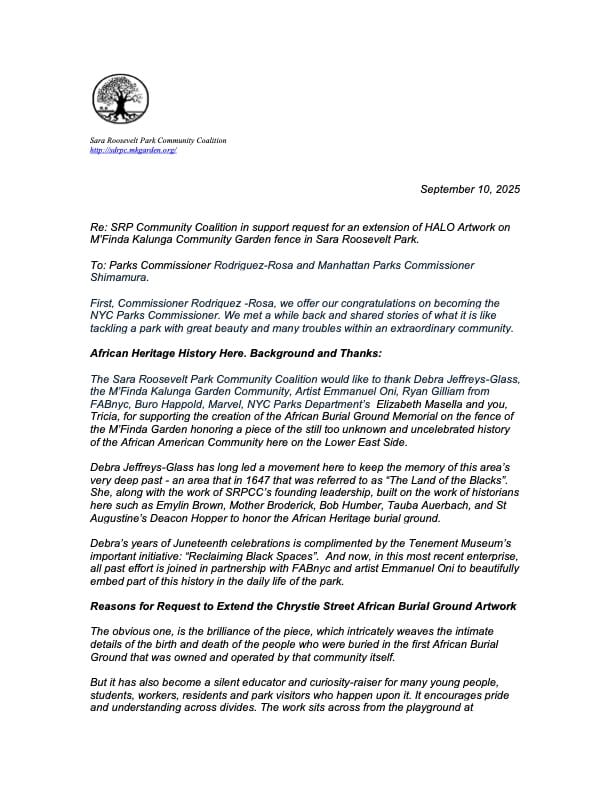
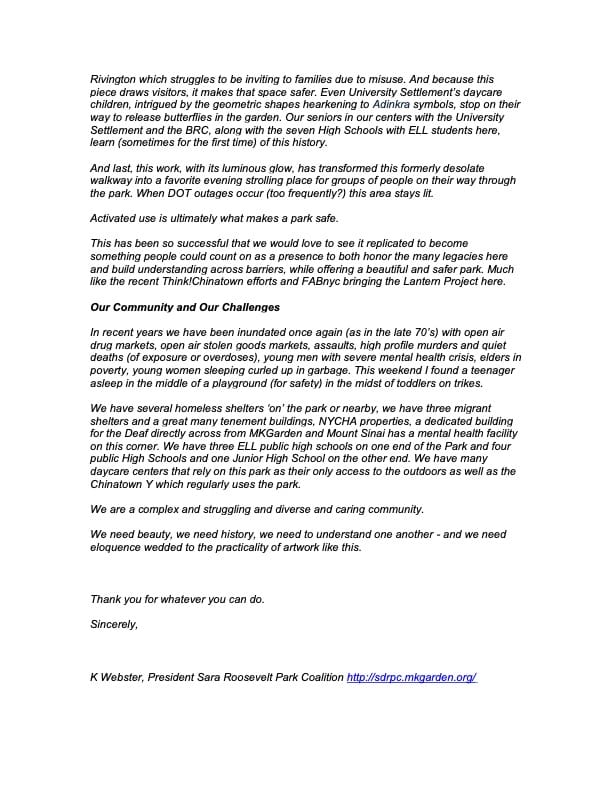
M’Finda Kalunga ?Community Garden?, through an initiative led and organized by resident, educator, and LES Community Hero Debra Jeffreys-Glass, has celebrated local Black history and shared the history of the Chrystie Street African Burial Ground at its annual Juneteenth festivities since 2004?.


In 2022, FAB began collaborating with Jeffreys-Glass and garden members to honor the unmarked Burial Ground. That work recently culminated in the commission and installation of HALO by artist Immanuel Oni.


IMMANUEL ONI is a first-generation Nigerian-American artist and space doula living between New York City and hometown Houston, TX. He believes design is not about what he is making, but who he is making it for. As for art, it is religion. His work explores loss, memory, and its deep connection with space. He utilizes spatial justice design and visual storytelling to unearth narratives related to trauma, healing, and ritual. His canvas consists of repurposing existing public space infrastructure such as light posts, fencing, underutilized green areas or mobile spaces to prompt community dialogue and connection. His aim is to fuse the physical with the spiritual. He has led and participated in international art and urbanism workshops in Venice, Hong Kong, and Lagos. He has been a Fellow for the Design Trust for Public Space, Culture Push, New York for Culture and Arts, More Art Engaging Artist Commission NY, and received awards from Naturally Occurring Cultural Districts NY, Office of Neighborhood Safety, Architectural League of New York, the New York State Council of the Arts, and commissioned by Fourth Arts Block (FABnyc) as the artist for the Chrystie Street African Burial Ground Memorial Installation in the Lower East Side. He is a former Director of Community Design at the New York City’s Mayor’s Office of Criminal Justice and Adjunct Professor at Parsons the New School for Design. He is the co-founder and Creative Director of Liminal, a non-profit that works at the intersection of art, unity, and space.


A native of Philadelphia, DEBRA JEFFREYS-GLASS came to NY to seek her fortune in the motion picture business in the mid-1980s. She moved to the LES in 1989, by way of the pre-gentrified Fort Greene area of Brooklyn. Despite the break-in on her first night on Norfolk street, she never looked back. She worked for 15 years as a production manager and production coordinator in film and television in NYC.  While she never quite found the pot of gold at the end of the film rainbow, she met her husband Ted on one of those film jobs, and found a different kind of gold – a wonderful life with a husband and two little boys who are now grown men. She and Ted found a loving community in their LES neighborhood, and became active in M’Finda Kalunga Community Garden. Twenty-six years later, they are both still passionately committed to this green space. Debra was a long-serving co-chair and is currently the garden’s treasurer, and has organized many garden events over the years, including Juneteenth celebrations in the garden since 2005. Debra serves on Community Board 3s Health, Seniors, Human Services and Education committee, and is currently VP of the SDR Park Coalition. She holds a BA in Radio, Television and Film from Temple University, a dual MSEd in Early Childhood and Childhood education from Bank Street College, and an EdM in Private School Leadership from Teachers College. She has been a classroom teacher and school administrator for the past 17 years, and currently earns her coins as the Elementary Division Director at The Calhoun School. However, she gets most of her wealth from working with like minded folks who want to make their corner of the world a better place.


CATHERINE MBALI GREEN-JOHNSON is a visionary cultural leader and reparationist with over 20 years of experience in arts administration, community advocacy, and social justice. As the Chairperson of the East New York African Burial Ground Committee, she has been at the forefront of preserving and honoring the sacred burial site located beneath the New Lots Library. Under her leadership, the committee’s community-driven visioning process has  secured  a  $7  million  renovation,  ensuring  the  site’s  restoration  and long-term protection as a space of remembrance and cultural significance.

Catherine is also the Founder of The Art of Reparations, a groundbreaking initiative that brings artists, creatives, and communities together to explore reparative justice through art, workshops, and public programming. In February 2025, she will launch The Art of Reparations podcast, creating a platform for dialogue on reparations through the lens of artists  and  culture  bearers.  She  facilitates  reparations  workshops  for organizations, foundations, agencies, and schools locally, nationally, and internationally.

In  her  role  as  Director  of  Programs  at  The  Laundromat  Project,  Catherine  curates programming  that  uplifts  communities  of  color,  supporting  artists  and  neighbors  as change agents within their own communities. Previously, she founded ARTs East New York, where she masterfully combined artistic expression and community engagement to  drive  social  change.  She  also  led  the  ReNew  Lots  Market  and  Artist  Incubator, transforming vacant land into a thriving space for local entrepreneurs and artists.

Appointed by the Mayor of New York City to the Cultural Affairs Advisory Committee in 2018, Catherine played a key role in shaping the city’s first cultural plan centered on equity and inclusion. Her work is deeply rooted in the power of imagination, storytelling, and ancestral research, ensuring that Black and Indigenous histories are honored and that communities of color have the tools to co-create radical, sustainable futures.

Catherine  continues  to  be  a  driving  force  in  cultural  preservation,  community-led development,  and  reparative  justice,  bridging  history,  art,  and  activism  to  create meaningful societal change.


A proud mother of 3, SHANNA SABIO was born in Brownsville, and raised in Bushwick and Bedford Stuyvesant.  She’s an anti-disciplinary artist, curator, cultural strategist, and public historian whose practice uses the intersections of art and technology, travel and urban planning to create healing, anti-racist, equitable, and inclusive spaces.

She’s co-founder and co-director of GrowHouse NYC, a community development cooperative that empowers Black people and our allies to collectively own and develop our communities resources, including property, cultural institutions and sites of memory, and artistic production.

GrowHouse was a founding organization of the Flatbush African Burial Ground Coalition, and has used Walking Tours, Art Installations, Technology partnerships, Events and Teach-ins, Partnerships with colleges and universities to raise awareness of the Flatbush African Burial Ground.

The BLAC Land Trust is part of GrowHouse’s strategy to catalyze Black staying power in Bed Stuy, Ocean Hill, Weeksville and Crown Heights., and will launch a campaign to secure the first collectively owned property in a portfolio in Spring 2025.


Read MoreResisting Cultural Erasure: Sharing Black Histories of the LES and Beyond
  • Post category:News